
The Miracles of St William of York
Following the death of William fitzHerbert Archbishop of York, in 1154 he was laid to rest inside York Minster cathedral. Within a few months, miracles were reported at his tomb by those who had come to honour him and pay their respects. In recognition of the miracles reported, William was canonised by Pope Honorius III in 1226.
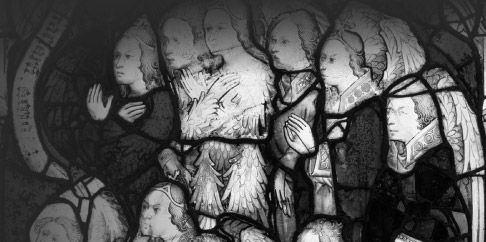
Across 95 panels of intricately detailed depictions, the St William Window in York Minster tells the story of William and the miracles attributed to him, in what was one of the largest narratives in stained glass ever made in Medieval England.
The First Miracle
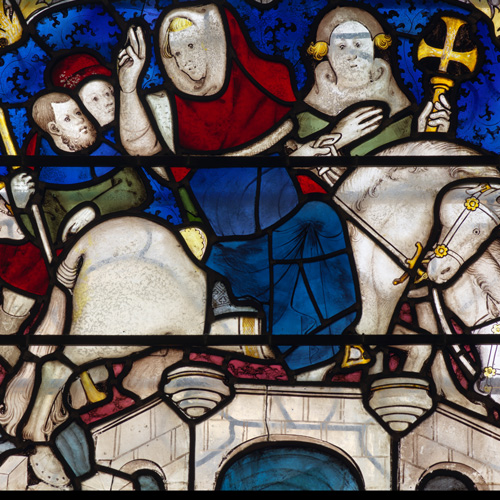
William was beloved by the people of York, and his reinstatement to the See of Archbishop in 1154 and return to the city was met with jubilant crowds. So many people came out to cheer and celebrate his return that as he crossed the river the weight of the crowds caused the timbers of Ouse Bridge to give way and collapse.
Large numbers of people were thrown into the river and were at risk of drowning. William, seeing the carnage, prayed to God for those in peril to be saved and he made the sign of the cross over them. All were saved.
This is considered William’s first miracle.
Miracles at the Tomb
Many miracles were reported at the tomb of St William of York where people from all walks of life, rich and poor, young and old, male and female travelled in pilgrimage to honour William and to seek help.
One miracle depicted in the St William Window tells of a woman who inadvertently swallowed a frog and then journeyed to St William’s tomb with her husband where she was cured by throwing it up.
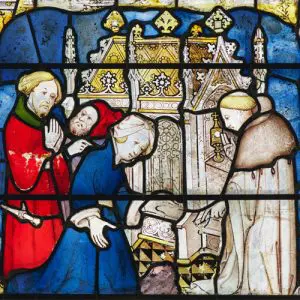
In 1223 a sweet-smelling oil flowed from William’s tomb. The flowing of holy oil was widely regarded as indicating sanctity and, though considered a commonplace saintly phenomenon William is the first English saint recorded to have performed this miracle.
There are numerous accounts of witnessed miracles at the tomb of St William from people who travelled from across the globe seeking help and healing. We can still relate to their concerns today: physical and mental illness, poverty, social injustice, concern for their loved ones, loss and grief.
Miracles to Protect from Danger
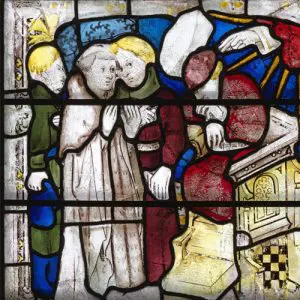
There are numerous reports of St William’s intervention to protect people from danger, from the King to a servant, all attribute their lives being protected to William of York.
Edward I, having accepted an invitation to attend the translation of the relics of Saint William, later has a near-fatal fall from a mountain whilst in Wales. The King was unharmed and he later ascribed his deliverance to have been from St William of York as he had promised to honour him.
A servant to one of the canons at York Minster fell asleep during Matins, whilst resting against the pulpit. A stone column of considerable weight fell on his head. Miraculously the servant is unharmed and he thanked the grace of St William and walked away.
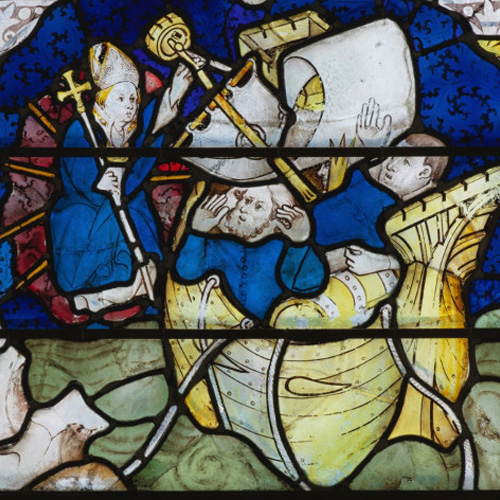
Sailors who were in danger of being shipwrecked, reported that St William appeared in a vision and their ship, which had suffered a broken mast in a storm was protected from running aground on the rocky shore.
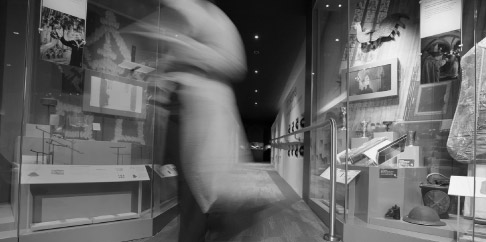
As we celebrate 800 years since the canonisation of William as a saint, take the rare opportunity to see pieces from his medieval Nave shrine returned to York Minster for the first time in almost 500 years. Explore his story and see precious artefacts which narrate the life of a man who devoted himself to our city and cathedral.
Plan a visit to our new exhibition.
All the images included above are panels from the St William Window at York Minster. Panel images above:
- ‘9c The miracle of Ouse Bridge’
- ’17c The woman is cured at the tomb’
- ’20d A servant is hit on the head by a stone’
- ’16e Saint William saves a ship with a broken mast’.
To explore further head to the York Glazier’s Trust Stained Glass Navigator to look closely at each panel and find out more of the miracles attributed to St William.
Restoring an international work of art
With one of the biggest conservation and restoration projects of its kind now complete, we caught up with Sarah Brown, Director of York Glaziers Trust, to talk about the Trust’s work over the last decade on the country’s largest medieval stained glass window.
The Great East Window has dominated York Minster’s East End for 600 years, with millions of people marvelling at its majesty over the centuries. But few have had the opportunity to study its content at close quarters, to develop our understanding of the story it tells or to uncover evidence of its creators, including the fingerprints of the original glaziers preserved in the glass.

So, for even the most experienced expert at York Glaziers Trust (YGT), the chance to work on the internationally renowned stained glass window has been a unique career highlight.
The Trust’s involvement started as early as 2005, when the need for extensive work on the East End’s stone and glass first emerged. At the time, Sarah Brown was a trustee of York Glaziers Trust, becoming its Director in 2008.
“It was such an enormous project and so demanding that it was clear that, to complete it to its full potential, it was going to need a remarkable mix of skills,” she explained.
At the start of the project, only basic details were known about the window’s history. Material from the Minster’s archives showed it had been created by master glazier John Thornton, of Coventry, between 1405 and 1408, and that he was paid £56 for his part in its completion. The window depicts the beginning and end of all things, from the Book of Genesis to the Apocalypse, but little was known about the window’s story, and the biblical sources and medieval vision it represents.
“It has become clear during the project that its extraordinary monumentality was always taken into account by its creators – it was always meant to be read from the floor of the cathedral,” Sarah explains.
Other hidden details about the window’s creation were also discovered when conservators began examining the glass.

“I think we all found it thrilling when we started to find little scraps of physical evidence of the people who had been working on the window originally – fingerprints in the paint and marks left from filaments of clothing when it had been fired in the kiln,” Sarah added.
“It connected you with the people who, like you, had been working on the window centuries before.
“We also found graffiti from the 1820s including the names and ages of the craftsmen and young apprentices. It’s quite moving to come face to face with someone who has put his name and age against his work – some as young as 14.”
But the project has not just involved preserving the window’s history, it’s also required the team to devise new ways to protect its future through a new, state-of-the-art protective glazing system. The solution chosen was a new UV resistant, hand-blown glass manufactured by Glasshϋtte Lamberts in Germany. The cathedral was the first building in the UK to use the glass, with the widest worldwide use to date.
“We had considered at an early stage if we could use UV resistant glazing but the materials available at the time were not suitable,” Sarah explains. “It seemed immensely providential that a new UV glass came on stream just at a time when we could use it. We could protect the window from its traditional enemy – water – but the new glass meant we could eliminate its exposure to UV light, which was a real game changer.”
The Trust’s work on the project has been far reaching. As well as the conservation aspects, the team has worked with art historians, surveyors and members of the clergy to understand the history of the window and the narrative it tells. The funding from the Heritage Lottery Fund allowed it to open the Bedern Glaziers Studio where members of the public could see and speak with conservators working on the 600-year-old glass.
Other opportunities have included developing its work and systems for monitoring the glass, its photography to record the panels and training new staff including five apprenticeships which were created during the project.
So, with the project finally drawing to a close after more than a decade, how does it feel to see the finished window?
“It’s undoubtedly been a career highlight working on such wonderful glass. There’s no debate – the Great East Window is up there as an international work of art and we all feel immensely privileged to have been part of it,” Sarah explains.
“At the time we were working on the panels we could see how marvellous they were, but what we couldn’t judge was the impact when they were returned to the building – it looks wonderful and I’m thrilled.
“I think part of what the project has achieved is a massive increase in public awareness of the stained glass at the Minster and the treasure we hold. It’s a very, very special collection of glass and we’re hugely privileged to have it.”
Sarah Brown’s new book, The Great East Window of York Minster – An English Masterpiece, will be available to purchase from the York Minster Shop from mid-May 2018.
Stay up to date with York Minster
- Event alerts
- Seasonal services
- Behind the scenes features
- Latest Minster-inspired gifts