In the past, people might have thought it strange that hooded figures bringing death would be the highlight of a popular TV show in October 2025. But for anyone watching Traitors the question of who will stay, and who will be visited by the grim reaper, is a tantalising spectacle. Perhaps our mortality is so serious, that we can only talk about it lightly.
Rather like the many euphemisms we have for death, entertainment is simply another way in which we speak indirectly about difficult or unanswerable questions.
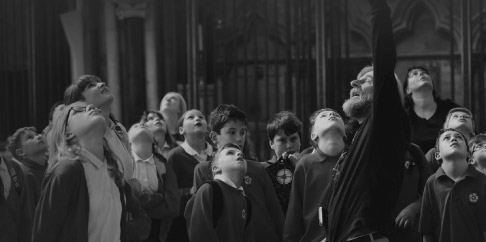
This week the Minster will be surrounded by children looking for small effigies of ghosts.
Hidden among railings and masonry, these figures are at the centre of an annual treasure hunt. As we approach Halloween, each evening will see some of the largest ghost tours of the year too. People out in the dark and the cold, being told chilling tales, and thinking about a York where different people once occupied the same space. It’s not for everyone, but the numbers taking part suggest that we continue to have a fascination with a past that dares to intrude on our present.
Our first reading this afternoon, from Ecclesiastes, seems appropriate to this season, taking a bleak if accurate view of the human condition and its inevitable end: “because all must go to their eternal home, and the mourners will go about the streets”. While the prospect of an eternal home may be welcome for those taking leave, the consequence of loss is inevitably mourning. In poetic language the author of Ecclesiastes reminds us of all that will be broken, and our return to dust.
A little while ago I was speaking to a member of the Minster congregation. Quoting words that come from a hymn we often sing, Immortal Invisible, she reflected that she was probably in the ‘withering’ stage, but not quite yet in the ‘perishing’ phase, of her life.
I think we can all recognise this reality, especially in autumn, when much of the natural world is shedding leaves and preparing for winter. We don’t find it easy to talk about ‘perishing’.
The author of Ecclesiastes similarly uses indirect language to speak about our mortality, when: the silver cord is snapped, and the golden bowl is broken, and the pitcher is broken at the fountain, and the wheel broken at the cistern, and the dust returns to the earth as it was…
The bowl in particular reminds us of one of the ancient understandings, in which our physical nature is simply a container for our spiritual identity. Like oil or incense, when the bowl is broken, our essence is released. People often question and criticise our indirect language for death. Yet, as the author of Ecclesiastes demonstrates, poetic words say more than plain speaking ever can. The same writer says that for ‘everything there is a season’, and maybe direct words serve one purpose, and poetry another. The skill – the wisdom – is to judge the occasion and find the words that fit.
Living healthily with an awareness of our mortality has always been seen as a critical aspect of Christianity. It’s something alluded to in the second reading, from the Letter to Timothy.
It is the seriousness of a soldier’s work, and the risk it carries, that distances them from everyday concerns. The awareness that death might descend suddenly reframes the soldier’s perspective on life. The author of the letter suggests that Christians are in the same boat – living a life alert to its risks, but also with the conviction that God is with us at all times, and for eternity. The key thing, the letter to Timothy says, is not to become ‘entangled’ with the earthly so much that we miss the Divine.
Having lived in what is believed to be one of the most haunted properties in York, the ‘Plague House’, I can’t tell you that I’ve seen any spirits. But living in a property that’s centuries old was a daily reminder that people have gone before us and will come after us.
To live with that sober reality, even if we take it lightly at times, is a healthy way to sift the wheat from the chaff. To focus on a faith that will last, and to be “strong in the grace that is in Christ Jesus “.
Amen.
Stay up to date with York Minster
- Event alerts
- Seasonal services
- Behind the scenes features
- Latest Minster-inspired gifts