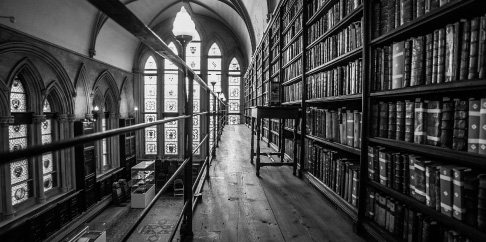

I have spent a lot of time in the last couple of weeks going through a lot of old papers that I‘ve got at home. I have been trying to sort out what can and should now be sent off to be shredded. I haven’t found it is easy. The reason I have so much paperwork is that I have always thought to myself, “well you never know when you might need it”. Whether “it” is the expenses receipts in relation to my tax returns from 50 years ago, or the minutes of PCC meetings from 40 years ago. So boxes and boxes of papers have been amassed over the years. And that’s why I have some sympathy with the young man at the centre of our story in Matthew’s gospel this evening. He was a young man who had collected not a lot of paperwork but many possessions, which of course made him quite rich.
He was probably quite well known, as in those days there were not a lot of wealthy people. We know very little about him other than that in his short life he had collected a lot of stuff, and he was making sure he held onto it very tightly. Whether it had been hard or easy for him to amass things we don’t know. But we do know that his stuff and hanging onto it was very important to him. I am sure he also thought to himself “I never know when I might need it”. He would have seen it as giving him security for the future. But it certainly didn’t bring him satisfaction. Our Old Testament lesson said: “The lover of money will not be satisfied with money; nor the lover of wealth, with gain.” And also: “the abundance of the rich will not let them sleep”.
He knew that there must be more to life than he was experiencing. And he had obviously heard about Jesus and Jesus’ talk of the Kingdom.
As I expect you know the idea of the Kingdom was central to what Jesus talked about wherever he went. He expressed it in many ways. Sometimes he spoke directly about the kingdom. Today we are remembering the apostle Matthew and one of the main themes of his gospel is that of the Kingdom of God, and that Jesus was the long-promised King. So, at the beginning of his account of Jesus’ ministry we read in chapter 4 that after Jesus had returned from being tempted in the wilderness: “from that time he began to proclaim, ‘repent for the kingdom of heaven has come near’”. And at the end of the same chapter after he had called Peter and Andrew to follow him, we read: “Jesus went throughout Galilee teaching in their synagogues and proclaiming the good news of the kingdom”.
But sometimes he used other language. He talked about eternal life, but when he did he was talking about the same thing. As we read and get to understand what Jesus was saying about eternal life, we can see that he is not talking about life after death, but he is talking about the rule of God in our lives here and now. The Kingdom.
And what Jesus was announcing as he travelled and preached was that not only was this rule of God, this Kingdom, imminent, but that he had come to bring it into being.
Now, this idea of the Kingdom wasn’t entirely new. The Jews had believed for some time that there would come a time when God would intervene on the earth and bring about a new state of life, a life in which all that was bad would be done away with and a new kind of life would be ushered in. And this was spoken of as the “life of the age to come” or “eternal life”.
And for the Jews of Jesus’ day, the critical question was, when this happened, when God did finally intervene, “who would inherit this life of the new age? Who would get eternal life? Who would be entering into this new Kingdom.”
Their understanding and their teaching was that those who would get this new life would be those who keep the law i.e. the Jewish laws. There were of course the laws God gave to Moses, best summed up in the 10 commandments, but then different groups had added their own “extras”. And much of Jesus’ life was spent confronting and being confronted by those who were adding extras.
You may recall towards the end of this gospel Matthew records a series of encounters where Jesus denounces the scribes and pharisees for some of those extras they were adding to the law. One example was that they were insisting that people should give a tenth of the pots of herbs in their herb drawers rather than focussing on justice and mercy.
So when this young man asks Jesus how he can get this life for himself, Jesus gives the classic answer – “Keep the commandments”. “Which ones?” he asks. Jesus answers by listing the commandments that deal with our human relationships. And the young man says that he has obeyed all those, so what else must he do. He knows he won’t make it as he is now, so what must he collect to add to his tally of law keeping. He was after all good at collecting – it’s what he had spent his life doing – so what extra thing now did he need to do.
Jesus doesn’t add anything complicated, or indeed anything detailed, he gives a remarkably simple answer – “sell all that you have!” Tom Wright puts it like this: “In order to be complete you must be empty. In order to have everything, you must have nothing. In order to be fully signed up to God’s service, you must be signed off from everything else.”
Selling everything is not something Jesus said to everyone he met, but he did say it to this man, because as always Jesus was scratching where people itched. And this is where this young man itched. And how!
The kingdom that Jesus was bringing into being, or the life of the age to come, eternal life, is all about the absolute priority of putting God first in our lives. Belonging to God’s kingdom, having God’s life within us, is never just an add on, or something extra we do. It is to be the centre of everything we are and everything we do. It sets the standards and values which will define how we live. And that way of life will often be in contrast to the way everyone else lives around us.
At the centre will be the love of God that has reached us, found us and welcomed us. A love that accepts us unconditionally and for ever just as we are. And having been found by that love, we will begin to demonstrate that love in the way we live and the way we relate to those we live and work with, as well as to those who happen to just cross our paths. We are to reach out, to welcome into our midst and to meet each other’s needs as best we can. And we will want to see that attitude of looking out for others, particularly those who are in any kind of need, at the heart of our civic and national life, and indeed across the world.
And so I will return to clearing out yet more papers this week, remembering and reflecting on all I have collected over the years. And my prayer is that as I do so I will remember that my faith is not yet another thing I collect and add to everything else I do, but is to be the mainspring of my life affecting how I live each and every day.
Amen.
Stay up to date with York Minster
- Event alerts
- Seasonal services
- Behind the scenes features
- Latest Minster-inspired gifts