At the moment there seems to be a lot of appetite for big stories.
Cinemas are filled with people wanting to watch Christopher Nolan’s epic re-telling of The Odyssey. When I went to see it, the theatre was fairly full, with a wide age span among the audience. Young and old gripped by a story thousands of years old and often regarded as one of the most important works in European literature.
Our first reading, from 1 Kings, was written about 100 years later than The Odyssey. It comes from a very different culture, although one influenced by neighbouring nations and the captivity of Judah by Babylon. In the passage we just heard, much emphasis is made of the beauty and wealth put into the Temple’s construction. There is more gold leaf than in the Oval Office! Such a big building project served many purposes.
In this large and ornate structure, the Ark of the Covenant was housed. Containing the Ten Commandments, the Ark had travelled with the people of Israel and became the centrepiece of the new Temple. It brought together the people’s history; their governance under God; and the achievement of becoming a settled nation. The Temple was the place God dwelt – and also a critical link between divine authority and the King as the chief servant of God. Temple was the place people came to make sacrifice, and it was a symbol of Israel’s success.
By the time of our second reading, the Acts of the Apostles, all the splendour and wealth of the first Temple had gone. All the gold and other items of value had been broken up and taken to Babylon. While a second Temple had been built, it too would soon be destroyed.
It’s interesting that these two Bible passages, placed together today, radically shift the spiritual focus of what is unfolding. In 1 Kings it’s the palatial grandeur of a stunning Temple; in Acts it’s a prison cell and the drama of the early church growing and spreading the good news of the resurrection. For Peter, the disciple of Jesus and a Jewish Christian, the Temple’s importance spanned his life. In particular, the Temple celebrated a foundational event of the Jewish people – the Exodus.
The Exodus story explained how Israel became a people, received the law, and were chosen by God. It’s primary meaning was that God freed the people, liberating them from slavery. In today’s passage from Acts, we find Peter in a similar state to the people of Israel in Egypt. He is confined, heavily guarded and in chains. It is an account that also reminds us of aspects of the resurrection. On that day angels rolled away the stone to let Jesus out. Here an angel releases Peter and the iron gate leading to the city ’opened… of its own accord’. The first person to greet Peter is a woman, Rhoda, who is so confused by joy that she runs to tell others and forgets to let him in! Like the women who first told the disciples Jesus had risen, Rhoda’s news is doubted – and the many had to confirm the word of the one.
For St Luke, the author of both a gospel and the Acts of the Apostles, the Exodus is central to his account of Jesus. In his life, death and resurrection Jesus has worked a new Exodus – a liberation from death and a new way to be with God. For this reason, Luke focusses on the transformative presence of Jesus, bringing us out of the dark prison of sin to freedom in a promised land. Not a promised land of physical space, but a spiritual home that means we can dwell with God both now and for all eternity. If the Temple celebrated the glory of God and the physical liberation of the people, the life of Jesus now assumes that role in a new covenant. It is no longer in an ornate Temple that God is manifest, but in the faithful lives of people born again in baptism.
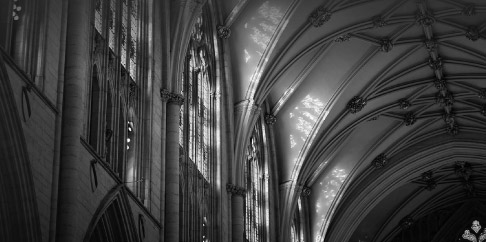
This is a seismic shift in the understanding of God, and Peter’s night-time release from prison is emblematic of that change. Time and again in his life, Jesus liberated people oppressed by illness, or sin, or an alien authority. This new Exodus frees people trapped in darkness and promises new life through God’s grace. When there are so many troubling issues in our world, and when power is exercised as oppression, the Church continues to proclaim its message of new life in Christ. It doesn’t take a building like York Minster to make that possible, it is an offer open to all, even those who find themselves in prison. Perhaps, especially, all who find themselves in darkness and know their need of God.
Amen.
Stay up to date with York Minster
- Event alerts
- Seasonal services
- Behind the scenes features
- Latest Minster-inspired gifts