
Meet Our Digital Surveyor
At York Minster, we’re shaping the future of heritage conservation. As a world leader in traditional crafts, we’re committed to pioneering the use of the latest digital technologies to help us protect, preserve and sustain our past.
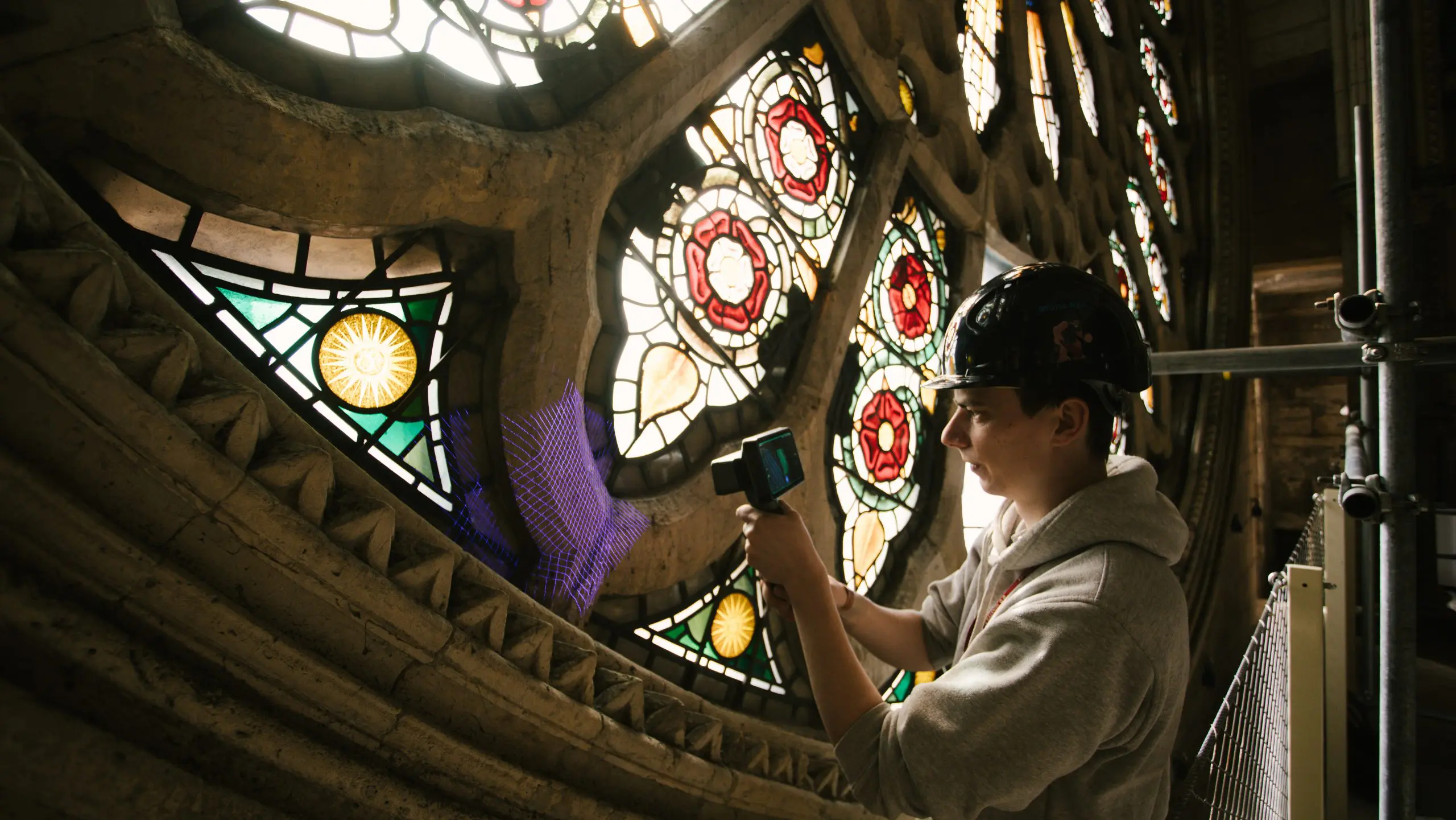
Luke, our Digital Surveyor, plays a vital role in this transformation. Using high‑precision 3D scanners, he creates incredibly detailed digital models of our centuries‑old masonry, architecture and artefacts. These innovations open the door to new restoration techniques and new ways for people to experience the Minster’s history.
Find out more about how Luke’s work is key to our ongoing conservation and preservation of York Minster and discover more about some of the projects he’s been working on:
Creating the Undercroft Museum
York Minster’s magnificent architecture with its medieval stained glass and handcrafted stonework tells the stories of the cathedral, the region and the Christian faith through the last eight centuries.
But travel underground, below the Minster’s floor, and you’ll discover a history dating back 2,000 years, to the Roman city of Eboracum, the Viking stronghold of Jorvik and a 9th century northern centre of power.
Two archaeological excavations during the last 50 years have unearthed layers of history shedding new light, not just on the story of York Minster, but also on the story of the city of York.
1967-1972: Emergency Excavations
Just over 50 years ago, York Minster faced one of its greatest challenges in recent history.
Surveys of the cathedral’s 197ft Central Tower revealed the 16,000 ton structure was sinking under its own weight, due in part to poor foundations at its base, and was at risk of imminent collapse. Emergency works to underpin the tower allowed archaeologists rare access to carry out excavations.
The project uncovered evidence of Roman activity on the site of the Minster, in what was once known as the city of Eboracum, which 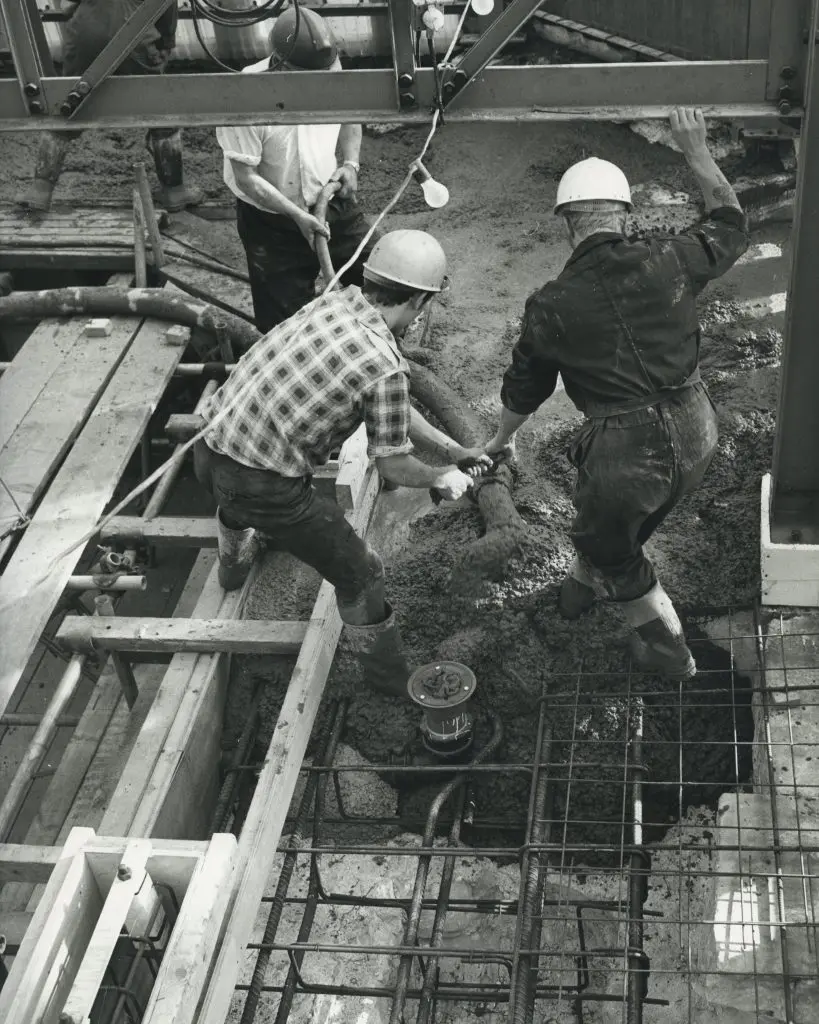 was established in AD 71. Remains of the Roman barracks, which at different times housed both the ninth and sixth legions of the Roman Empire’s army, were discovered beneath the cathedral. A column from the barracks’ Principia – or headquarters –, unearthed during the excavations has been reconstructed and now stands on the South Piazza, outside the Minster’s South Transept.
Other finds included evidence of an Anglo-Saxon cemetery and the foundations of the Norman Minster – the forerunner of the present cathedral.
2012: York Minster Revealed
More recently, archaeologists had the chance to explore the hidden history of the site as part of work to construct the cathedral’s state-of-the-art Undercroft Museum.
Findings included a rare silver coin called a sceatta. Its pristine condition allowed experts from the British Museum to date it to the beginning of the 9th century, which provides evidence of a major settlement – complete with its own mint – near the site of the Minster during the Anglo-Saxon period.
Other findings included evidence of a mid-11th century burial – the later era of Viking York. Archaeologists unearthed a cist burial – a type of grave – which was partly destroyed during work to build the medieval Minster in 1220. Archaeologists already knew there was 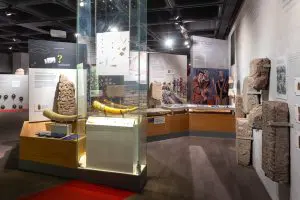 a cemetery on the site, but the finding has helped extend knowledge of the types of burial which took place here, and also the area the cemetery occupied, supporting evidence that the site was used as a burial ground for generations by both Anglo-Saxon and Viking residents.
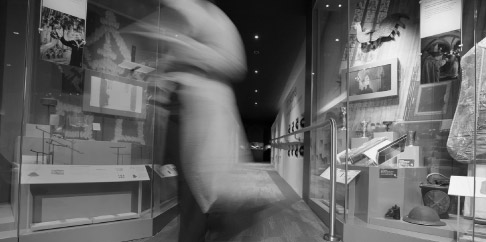
Archaeological discoveries from both excavations can be seen in the cathedral’s Undercroft Museum, entry to which is included with your sightseeing ticket.
Protecting our irreplaceable glass
York Minster holds the largest single collection of medieval stained glass in the country with 128 windows, the oldest dating back to the 12th century.
Currently more than 50% of the cathedral’s windows have no protective glazing, leaving them exposed to the elements and subject to corrosion and decay, meaning the irreplaceable glass could be lost for future generations.
To stop the decay, the cathedral has announced a 20-year partnership with York Glaziers Trust and an innovative fundraising campaign led by the York Minster Fund, supported by a £1m grant from the National Lottery Heritage Fund.
The initiative, which it is anticipated will cost £11m to complete, will see state-of-the-art, environmental protective glazing extended to all of the Minster’s 128 mostly medieval windows as part of a long-term strategy to buy time for much needed conservation work.
How you can help
We rely on the support of people like you to protect this incredible collection, because we cannot do it without you. For centuries, generous donors have helped create and conserve York Minster’s stained glass, and so we ask for your help now.
The Chapter of York has teamed up with York Minster Fund and York Glazier’s Trust to conserve the great St Cuthbert Window, a unique and monumental example of art, engineering and history. You can find out more about the amazing story of this important and beautiful window in our exhibition.
Every £1 you donate goes straight to supporting vital projects like this. If you’d like to support the campaign, you can donate to YMF online or see our Get Involved section for other ways you can help.
Conserving the St Cuthbert Window
York Minster’s St Cuthbert Window is one of the largest surviving narrative windows in Europe.
Located in the cathedral’s South Quire Transept, the St Cuthbert window tells the story of the life and miracles of one of Northern England’s most significant saints. It is thought to date from c.1440 and is the only surviving whole stained glass window dedicated to the life of the saint.
Three Great Medieval Windows
It is one of three great windows in the cathedral’s East End, which include the St William Window (c.1415) and the Great East Window, pictured left, (completed in 1408), both of which have undergone major conservation and restoration projects in the last two decades.
Now, after centuries of exposure to the elements, the stonework of the St Cuthbert Window and the wider South Quire Transept needs urgent work to replace and repair eroded and decaying masonry.
The conservation project is the subject of a major exhibition at the cathedral which opened in summer 2021 – Light, Glass & Stone: Conserving the St Cuthbert Window.
State-of-the-art Protection
To allow the work to take place, all 152 panels of stained glass were removed from the St Cuthbert Window in spring 2021, allowing painstaking cleaning and repair work to be undertaken by conservators at York Glaziers Trust.
Once the stained glass has been repaired, it will be returned to the window with state-of-the-art protective glazing, replacing external diamond quarry glazing installed in the 1930s and providing a barrier between the elements and medieval stained glass.
The glass work is part of a wider 20-year partnership project between York Minster and York Glaziers Trust to install internally-ventilated protective glazing to the cathedral’s windows, which comprise the largest and most diverse collection of medieval stained glass in the country.
Stonework Conservation
The original stonework of the South Quire Transept in which the window sits dates back to the 1390s, when the medieval masons used magnesian limestone to create its complex structure and framework, including the buttresses and the window’s decorative elements.
In the 18th and 19th centuries this area of the Minster was repaired with a poorer quality of the same stone, which was unusually porous and weathered quickly, and in the 19th and 20th centuries this was compounded by the use of Ketton stone for repairs, which reacted with the original magnesian limestone.
The result is extensive damage to parts of the stonework, with large cavities in places. The Minster’s stonemasons are repairing the structural damage using traditional techniques supported by scientific analysis.
You can see the St Cuthbert Window in detail and learn about the stories its stained glass tells via a new resource developed by York Glaziers Trust.
The Grand Organ Returns
York Minster’s Grand Organ returns following a major, £2m refurbishment, the first on this scale since 1903.
The instrument, which dates back to the early 1830s, was removed in October 2018 – including nearly all of its 5,000+ pipes – and taken to Durham for repair and refurbishment by organ specialists Harrison and Harrison.
The organ was returned to the cathedral last year with work carried out to rebuild the instrument before a substantial period of voicing began in November 2020. The restored organ returned to use as part of worship on Sunday 7 March 2021.
The organ plays a key part in the cathedral’s services, providing the heartbeat at the centre of daily worship within the church, and this once-in-a-century refurbishment will ensure it continues to allow world-class music to be performed at the cathedral for the next 100 years.
Dismantling the Grand Organ
Take a look behind the scenes as specialists remove one of the largest cathedral organs in the country for the first time in more than 100 years.
Since 1903, York Minster’s Grand Organ has been at the heart of daily worship at the cathedral. But this constant use combined with the heavy footfall in the Minster which throws up dirt and dust, and the building’s temperature changes and humidity, mean it is now in need of a major refurbishment to ensure its reliability into the next century.

The first stage in this two year, £2m project is to completely dismantle the organ, and during October 2018 this mammoth task is being carried out by a team of eight people from organ specialists Harrison and Harrison.

The team has been on site since 8 October and during the next three weeks will be carefully removing 5,379 pipes, which range in length from the size of a pencil to 10m long. This includes the 100 decorative case pipes which have been silent since the last major refurbishment in 1903 but will be returned to voice as part of the current project.

The case pipes date from the early 1830s and have a high lead content, meaning that the soft metal has bent and bowed in places under the weight of the pipes. Harrison and Harrison will reshape the pipes and line them with zinc to strengthen the structure, before graining and marbling specialists Robert Woodland and Son clean, repair and restore their decorative surfaces returning them to their original splendour.

Other work during the three week period includes removing the enormous organ console and lifting the blowers stored beneath the floor of the North Quire Aisle. The instrument will be transported to the team’s workshop in Durham for cleaning and repair works to be carried out, before work to reinstall the organ starts in spring 2020.
Learn more about the fiery origins of the organ under our Stories section, or to support the project see our donations pages.
Stoneyard Apprentice James Digger
We catch up with first-year apprentice James Digger about life at the Minster and his thoughts on #StoneFest18
Restoring an international work of art
With one of the biggest conservation and restoration projects of its kind now complete, we caught up with Sarah Brown, Director of York Glaziers Trust, to talk about the Trust’s work over the last decade on the country’s largest medieval stained glass window.
The Great East Window has dominated York Minster’s East End for 600 years, with millions of people marvelling at its majesty over the centuries. But few have had the opportunity to study its content at close quarters, to develop our understanding of the story it tells or to uncover evidence of its creators, including the fingerprints of the original glaziers preserved in the glass.

So, for even the most experienced expert at York Glaziers Trust (YGT), the chance to work on the internationally renowned stained glass window has been a unique career highlight.
The Trust’s involvement started as early as 2005, when the need for extensive work on the East End’s stone and glass first emerged. At the time, Sarah Brown was a trustee of York Glaziers Trust, becoming its Director in 2008.
“It was such an enormous project and so demanding that it was clear that, to complete it to its full potential, it was going to need a remarkable mix of skills,” she explained.
At the start of the project, only basic details were known about the window’s history. Material from the Minster’s archives showed it had been created by master glazier John Thornton, of Coventry, between 1405 and 1408, and that he was paid £56 for his part in its completion. The window depicts the beginning and end of all things, from the Book of Genesis to the Apocalypse, but little was known about the window’s story, and the biblical sources and medieval vision it represents.
“It has become clear during the project that its extraordinary monumentality was always taken into account by its creators – it was always meant to be read from the floor of the cathedral,” Sarah explains.
Other hidden details about the window’s creation were also discovered when conservators began examining the glass.

“I think we all found it thrilling when we started to find little scraps of physical evidence of the people who had been working on the window originally – fingerprints in the paint and marks left from filaments of clothing when it had been fired in the kiln,” Sarah added.
“It connected you with the people who, like you, had been working on the window centuries before.
“We also found graffiti from the 1820s including the names and ages of the craftsmen and young apprentices. It’s quite moving to come face to face with someone who has put his name and age against his work – some as young as 14.”
But the project has not just involved preserving the window’s history, it’s also required the team to devise new ways to protect its future through a new, state-of-the-art protective glazing system. The solution chosen was a new UV resistant, hand-blown glass manufactured by Glasshϋtte Lamberts in Germany. The cathedral was the first building in the UK to use the glass, with the widest worldwide use to date.
“We had considered at an early stage if we could use UV resistant glazing but the materials available at the time were not suitable,” Sarah explains. “It seemed immensely providential that a new UV glass came on stream just at a time when we could use it. We could protect the window from its traditional enemy – water – but the new glass meant we could eliminate its exposure to UV light, which was a real game changer.”
The Trust’s work on the project has been far reaching. As well as the conservation aspects, the team has worked with art historians, surveyors and members of the clergy to understand the history of the window and the narrative it tells. The funding from the Heritage Lottery Fund allowed it to open the Bedern Glaziers Studio where members of the public could see and speak with conservators working on the 600-year-old glass.
Other opportunities have included developing its work and systems for monitoring the glass, its photography to record the panels and training new staff including five apprenticeships which were created during the project.
So, with the project finally drawing to a close after more than a decade, how does it feel to see the finished window?
“It’s undoubtedly been a career highlight working on such wonderful glass. There’s no debate – the Great East Window is up there as an international work of art and we all feel immensely privileged to have been part of it,” Sarah explains.
“At the time we were working on the panels we could see how marvellous they were, but what we couldn’t judge was the impact when they were returned to the building – it looks wonderful and I’m thrilled.
“I think part of what the project has achieved is a massive increase in public awareness of the stained glass at the Minster and the treasure we hold. It’s a very, very special collection of glass and we’re hugely privileged to have it.”
Sarah Brown’s new book, The Great East Window of York Minster – An English Masterpiece, will be available to purchase from the York Minster Shop from mid-May 2018.
Conserving the Great East Window
York Minster’s Great East Window is the largest expanse of medieval stained glass in the country, a masterpiece in glass and stone depicting the beginning and end of all things.
(2012-2018)
In 2012, the National Lottery Fund made a transformational grant of £10.5 million to enable us to undertake York Minster Revealed, a £20 million major research and conservation project at York Minster that was completed in 2018. Central to the project was conserving and reinstating the 600-year-old Great East Window, the largest single expanse of medieval stained glass in Britain.
The window is the masterpiece of Coventry glazier John Thornton and was commissioned in 1405. it took three years to complete, according to information gleaned from 17th-century copies of the medieval contract, which has long been lost. The window was a work of immense ambition, depicting the beginning and end of all things, from the creation of the world as described in the book of Genesis, to the events that will presage the end of the world and the second coming of Christ as told in the visionary Book of Revelation, known in the Middle Ages as the Apocalypse.
The project was not just about conservation; it provided apprenticeships in craft skills; it transformed the visitor experience through the provision of new facilities to improve access and the creation of York Minster’s state-of-the-art interactive Undercroft Museum, and digital displays to support interpretation of the Great East Window. In addition it enabled a new audience development plan and development of a learning programme to engage with new and existing audiences.
Craftsmanship
All 311 stained glass panels were removed from the 15th-century window, which is the size of a tennis court, in 2008 so York Glaziers Trust could begin the mammoth task of restoring the fragile masterpiece.
The project, which also involved the conservation or replacement of nearly 2,500 stones by York Minster’s stonemasons, was part of the cathedral’s £15m York Minster Revealed project, which ran from 2011 to 2016.
The project has involved the installation of state-of-the-art UV resistant protective glazing, which was the first time the material had been used in the UK and the largest worldwide use to date.
During the first phase of the project (2012-2016), the 157 panels narrating the Apocalypse were removed and painstakingly conserved at the York Glazier’s Trust Studios. In the second phase (2016-2018), the conservation of the remaining 154 panels was carried out. The panels were returned to the Minster following parallel work on the masonry at the East End, which involved the conserving or replacing of nearly 2,500 stones.
Previous protective glazing had acted as a weather shield, keeping pigments, lead, conservation materials and the original glass dry; however, it had not been an adequate barrier to ultraviolet radiation, which reacts with any epoxy resin used in the conservation of the stained glass, leading to a yellowing discolouration of that resin after prolonged exposure. For the York Minster Revealed project, a layer of new, state-of-the-art restauro®UV glass was added, so that each panel is now protected by this revolutionary external glazing incorporating UV-resistance within the structure of the glass itself. This was the first time this glass had been used in the UK.
It is reassuring to know that we are now able to offer total environmental protection for all aspects of the conserved window.
– Sarah Brown, former Director of York Glazier’s Trust
Fundraising
Although the Great East Window project is now complete, our work to protect our irreplaceable medieval glass is far from finished. The cathedral has launched an £11m, 20-year project with York Glaziers Trust to add environmental protective glazing to more than 70 of its unprotected windows, buying time for much needed conservative work.
The project is supported by an innovative fundraising campaign organised by the York Minster Fund (YMF) and the Heritage Lottery Fund (HLF). This involves a National Lottery grant of up to £1m from the HLF to match every pound raised by the public and YMF, which will be used to establish an endowment fund to help pay for the £11m project.
This means that for as little as £1, you can help us to protect our medieval masterpieces for future generations. If you’d like to support the campaign, you can donate online.
Caring for the South Quire Aisle
The South Quire Aisle will be one of the cathedral’s main conservation and restoration projects for the next decade.
The scheme involves work to repair and replace stone and glass in 15 window bays, which will take around 11 years and cost £11m.
Six centuries of exposure to the elements
The South Quire Aisle dates from 1361 and its construction took around 60 years to complete.
It bears dramatic evidence of six centuries of exposure to the elements, with issues including extensive cracking and erosion to the stone work and serious damage to the medieval glass, which has buckled and cracked in places allowing water in.
Damage caused by a 19th century arsonist
The area suffered serious damage during the 1829 fire, started deliberately by local resident Jonathan Martin in the Quire.
The graffiti marks of the 19th century glaziers – and even those of their sweethearts – who repaired the windows following the fire can still be seen.
21st century craftsmanship
The project began in 2016 and work to date has included the carving of new grotesques and the restoration of pinnacles and buttresses.
How you can help
York Minster relies on your generous support to help fund our conservation and restoration work. If you’d like to help, you can donate to YMF online, or see our Get Involved section for other ways you can support our work.
Stay up to date with York Minster
- Event alerts
- Seasonal services
- Behind the scenes features
- Latest Minster-inspired gifts