
Palm Sunday: The Crowd’s Last Word – The Very Revd Dominic Barrington, Dean of York
Title: The Crowd’s Last Word
Preacher: The Very Revd Dominic Barrington, Dean of York
Date: Palm Sunday, 2 April 2023 10.30am
Last words are for fools who believe they have not yet said enough, remarked Karl Marx on his own deathbed. You might agree with that, although it feels a slightly aggressive way in which to take leave of this life. I suspect that, when the time comes, my own preference might be closer to that of the economist John Maynard Keynes, who sadly remarked I only wish I had drunk more champagne!
Or it might prove to be the case that we are overwhelmed with regret, and echo a sentiment more in keeping with the last words of Queen Elizabeth I, who is reported, wistfully, to have said All my possessions for a moment of time.
But whatever faces us at the end of our own lives, today, and throughout this week of weeks, we are called by God and by God’s Church to work out what our last word is when faced, as we are right now, by the Cross, and by the death of Jesus. Because it is no use claiming to be a follower or a disciple of Jesus, if you have nothing to say to the world about the Cross – for the Cross stands not just at the heart of our religion. For the Christian, the Cross stands – the Cross must stand – at the heart of the life of the world.
And it is not just Christians who can find themselves confronted with the Cross. In 1972 the American Jewish author and rabbi Chaim Potok wrote a remarkable novel entitled My name is Asher Lev, about a child born into an ultra-Orthodox Jewish family in New York, a family very like his own. And it turns out that this child is blessed with the gift of truly remarkable artistic talent.
But, while you or I might delight to see such talent in one of our own offspring, in the context of a devout, ultra-Orthodox Jewish community, this was very far from welcome, for art, painting and drawing do not sit well in Orthodox Judaism, which takes very seriously the prohibition on making graven images.
But so very talented is this child that, with the eventual encouragement of their rabbi, his parents arrange for their son to have lessons in art from a non-religious Jew who possesses similar talent.
The climax of the story comes when the teacher tells his ever-blossoming pupil that if he wishes to be a truly great artist, he must go down to the Met – the Metropolitan Museum of Art – and gaze at, and study, and sketch, and reproduce all the great paintings of the crucifixion in the museum.
The boy is horrified at the idea that he, an Orthodox Jew, should be encouraged to immerse himself in pictures of the ultimate expression of the Christian faith. But his teacher is clear – no other image in the world, he says, has the significance in the entire history of art as does the crucifixion of Christ. To be a truly great artist, whatever one’s faith or beliefs, one must encounter the cross of Christ.
In other words, this committed, observant Jew is called to find his ‘last word’ on – of all subjects – the Cross.
This morning, as we begin Holy Week, we find ourselves faced with a body of people that the evangelists refer to as the ‘crowd’. And because of the curious, unique nature of today’s liturgy we have had not one but two snapshots of the crowd in this morning’s service – which is both helpful and necessary if we are to understand what being part of a ‘crowd’ can really mean.
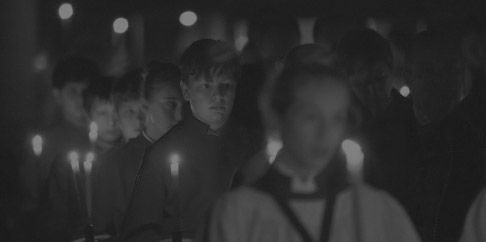
Just now, as we gathered outside the Minster, we acted out the crowd’s behaviour as it followed Jesus down the Mount of Olives, celebrating his arrival in a Jerusalem turbo-charged with religious fervour at the celebration of the most significant Jewish festival of the year. And, as the evangelist reminded us, so excited is the crowd, it is shouting Hosanna, and calling Jesus the Son of David , and claiming that he has come ‘in the name of the Lord’.
But crowds are easily swayed, and – as we see all too often in our own volatile political and social climate – people can veer from being superstar to public enemy number one in little more than a heartbeat. When the going gets tough, both 2000 years ago, and all too often today as well, a crowd can change its communal mind and change the chant of Hosanna to the hideous last word that cries out, Let him be crucified.
And so, today, God asks us, God demands of us once again, to work out what the Cross really means to each one of us. God asks us what it is that we might say to the world around us about the Cross and about the death of Jesus. Are we outwardly going to shout Hosanna, but let our inner thoughts and our behaviour call out Crucify? How will we fashion our own response to the Cross?
I want to suggest that if you – or I – properly wish to answer this question, the ultimate question of Holy Week, then you need to walk with Jesus throughout this week through the great liturgies of the Church. For if, after this morning, the next time you set foot in a church is next Sunday morning, I am not sure that you will properly have understood what it is that God in Jesus has done for you, and I am not sure that you will fully understand what it will mean to celebrate resurrection on Easter Sunday. And that is why the Church of God has, for many many centuries, offered unique and powerful liturgies to help us enter into this ultimate, great drama of hope and of salvation.
And so I invite you to join us in the coming days. To join us tomorrow, and Tuesday and Wednesday, as we are reminded of Jesus’ last days of teaching his disciples and friends as the situation around him ineluctably comes to a head.
And then to join us in the solemn darkness of a Thursday night, replete with its bread and wine, and acts of service; to join us in the bitter darkness of a Friday afternoon, complete with an agonizing and undeserved death; to join us in the expectant darkness of a Saturday night, as the light of a single candle will illumine your life more brightly than you could have thought possible.
And if we are faithful to God’s call, and make such a journey, then we will comprehend so much more clearly what God has done for us on the Cross, and then can we frame our own last word to help us speak – as we are called to do – speak to the world of the death of the Son of God.
For now, right now, the crowd chants Crucify…Let him be crucified. Is that going to be your last word?
May the Lord establish his word – The Very Revd Dominic Barrington, Dean of York
Title: May the Lord establish his word
Preacher: The Very Revd Dominic Barrington, Dean of York
Readings: 1 Samuel 1.20–28, Colossians 3.12–17, John 19:25-27
Date: The Fourth Sunday of Lent, Mothering Sunday, 19 March 2023 11.00am
May the Lord establish his word.
Meanwhile, so we are told, ‘Hannah conceived and bore a son’. And so our readings begin on this day when maternity seems to leap to the forefront of our minds. And Hannah’s story isn’t any old story of childbirth – for if you read back a mere fifteen verses, you’ll discover that Samuel’s birth is an extraordinary birth, because in the opening verses of the first book that bears his name, it is explained to use that ‘the Lord had closed [Hannah’s] womb’.
So Hannah isn’t just any old mum – she’s someone who had to work hard to become a mum – and not just the mother of any old child – she becomes the mother of someone after whom not one but two books of the Bible are named. What, you might ask, could be better than that to start our celebration of Mothering Sunday
Well, Hannah is – without any doubt at all – a person of very considerable significance in the story of the people of God, and how that story is narrated in holy Scripture. But her story is, perhaps an odd choice if this morning is meant to be a pastorally effective celebration of maternal values and aspirations. A role model who has had a lucky break from infertility might not be the best example for us to hold up in such a context, let alone in any way endorsing the Biblical understanding that it was God’s purpose and decision to ‘close her womb’ and subject her to such grief.
And, in an era when we take issues such as parenting and safeguarding very seriously, one might have to question whether a narrative that sees this sometime barren Hannah give birth, only to leave her baby abandoned at the Temple as soon as he has been weaned, is quite the most appropriate story for a celebration of maternal spirit.
And if you should read on a little, you will discover that the family with whom the baby Samuel has been left is seriously toxic. Eli, the High Priest, is, shall we say ineffectual. His own adult sons are, so the narrative tells us, ‘scoundrels’ – both stealing from the offerings made in the Temple, and sleeping their way through the female members of the Temple’s equivalent of hosts and stewards. This is a far from ideal adoptive family in which to leave a vulnerable small child.
All of which means that we are going to have to work a little harder if we are going to understand why Hannah’s story was read to us just now as part of our celebration of Mothering Sunday, and while we work it out we should continue to pray: May the Lord establish his word.
Meanwhile, about a thousand years or so after the era of Hannah and Samuel, another servant of the one God, was reminding his community about the importance of love. Now – surely we can talk about love on Mothering Sunday – what could be more appropriate than that?
But this choice is not entirely straight-forward either. For a start, you might want to question the pastoral sensitivity of a passage like this for those who were unfortunate enough to grow up in a context of parental abuse, or who may have found it difficult if not impossible to forgive a mother who may not have been someone that either demonstrated love or was easy to love.
And, again, if we dare to read on a little, in this case only as far as the very next verse of Colossians chapter three, we come across those ever-challenging words, “Wives, be subject to your husbands, as is fitting in the Lord.” Well, I’ve been ordained 28 years this summer, and I’ve done a fair few weddings in that time, but I have yet to have a couple ask me if they can include the now infamous word ‘obey’ in a wedding service, which was relegated to being an option 95 years ago.
So, again, we may have to dig a little deeper to work out how this passage – which, despite the claim made at the start of the reading was almost certainly not written by Paul – helps fulfil that brief and simple prayer: May the Lord establish his word.
Meanwhile, three hours ago, I was presiding and preaching at our early service at 8am. Now our custom at the early service – like many churches around the country – is to use the 1662 Prayer Book. So at 8 o’clock, you’d not have heard anything about Hannah, you would not have heard from Colossians, and you would not have joined the Mother of Jesus and the Beloved Disciple at the foot of the cross.
Instead, you would have heard part of the fourth chapter of that genuine Pauline letter which he wrote to the church in Galatia. A rather tortuous and complex passage where Paul is talking about Isaac and Ishamel, the two sons of Abraham, and their respective mothers, which he sees as being allegorical. And thus, three hours ago, you’d have heard Paul speaking (and speaking in Elizabethan English) that Hagar, the mother of Ishmael, ‘is Mount Sinai…and answereth to Jerusalem which now is, and is in bondage with her children. But Jerusalem which is above is free; which is the mother of us all.”
Now the tradition of reading that text on the fourth Sunday of Lent goes back well beyond Cranmer’s prayer books, possibly as far back as the Eighth Century. And this curious and oblique remark about the heavenly Jerusalem being the universal mother, and its proclamation for hundreds of years in the middle of Lent – that is what has led to this day being known as Mothering Sunday.
Meanwhile, in 1908 in a small town in what was the coal-mining country of West Virginia, a social activist and devout member of what is known as the Methodist Episcopal Church, inspired by a prayer from her Sunday School days, founded an annual commemoration each May called Mother’s Day. The very next year the idea was picked up in the great metropolis of New York, and by 1914 Woodrow Wilson had issued a proclamation declaring the second Sunday of May to be nationally recognized as Mother’s Day. But all of that, as it so happens, is a completely different story, and not a story that relates to today’s celebration, even though Anna Jarvis, its creator, would, I am quite certain, have been happy to pray May the Lord establish his word.
Meanwhile, on an ugly hill that, in reality, was anything but green, some 2000 years ago, Jesus was busy dying. Except, if you read the Fourth Gospel properly, with your eyes and ears and mind open to exactly what its author is trying to tell us, Jesus is actually busy triumphing. For that is how St John understands what is happening as the Word made flesh is crucified.
And Jesus is about to announce, triumphantly, that everything has been accomplished. Jesus is about demonstrate that Love has fulfilled and completed all that it had set out to do. Only one last task remains, and thus John’s account of the death of Jesus is, as it were, interrupted, as he tells us in the passage chosen for this morning’s gospel reading, that Meanwhile, standing near the cross of Jesus were his mother… and, along with some other women, that curiously hard to identify figure known as ‘the disciple whom Jesus loved’. And the final task that Jesus must accomplish is, indeed, to fulfil the prayer of Elkanah, ‘that the Lord may establish his word’.
For this is the moment when Jesus’ vocation is, truly, perfected. And that is why, on Mothering Sunday, we are called back to witness anew Jesus’ final, decisive action. And it is not an action about a woman called Mary, and possibly a disciple called John – for I am quite certain that the evangelist uses titles and not names, because he knows Jesus is doing something bigger and more important than just making sure his mum has a roof over her head.
For in this final moment, the Fourth Gospel shows us the Word made flesh bringing together the one who bore the Word and the beloved community called to witness to that Word. This, if you like, is Jesus symbolically creating the Church – the beloved community of his followers – and it is with this task achieved that he can cry, victoriously, that all is not merely finished but made complete and perfect.
So let’s get real about Hannah. Let me tell you the truly remarkable thing about her. She is not just the first, but the only figure in the entire Old Testament whom we see indulging in what we now would call intercessory prayer, and getting it answered. She could be the subject of an entire sermon that I don’t now have time to preach, but go read her story properly.
Hannah is not important because she’s a mother. She’s important because she had the insistent vocation to lift up her plight to God by walking into the sanctuary of the Temple, and, in doing so, she makes a difference – a difference not just to her own life, but of her entire community. And through her the Lord established his word.
And that quasi-Pauline figure who wrote to the Colossians. He demanded that the beloved community we call the Church of God functioned as one body – a body bound together in the perfect harmony of love – a body in which, ‘richly’, the word of Christ dwells.
And meanwhile… as the Fourth Gospel shows us Jesus ensuring that the Living Word is established in the community of the Word, right now, on Mothering Sunday, we are called again to remember our vocation as members of God’s beloved community.
We are called, in this our own generation, to ‘establish the Word’ – to witness to the Word, to pray with the Word and through the Word – to pray for the world and to go into the world and make a difference.
Indeed, to pick up the real meaning of the Hebrew translated as ‘establish’, we are called to make the Word ‘rise up’. To make God’s Word rise up by our witness and by our actions. And that, perhaps, is what is means for the Church to recall its vocation to the mother of all people.
Amen.
Being in the love of God – The Very Revd Dominic Barrington, Dean of York
Title: Being in the Love of God
Preacher: The Very Revd Dominic Barrington, Dean of York
Date: The First Sunday of Lent, 26th February 2023 4.00pm
When your children ask you in time to come, ‘What is the meaning of the decrees and the statutes and the ordinances that the Lord our God has commanded you?’
If you happen to listen to the Sunday programme on Radio 4 this morning, you would have heard a fascinating piece this morning about the West African religion Ifá, introduced by the BBC journalist Peter Macjob who has embraced this religion, and left behind the Christianity into which he was born.
He explained that he had been born into a very devout Roman Catholic family, and had been baptized, confirmed, had been an altar server, and had even considered going to seminary, before he got disillusioned. He talked about how his reading of some major moments of church history, such as the councils of Nicaea, Trent, and even the Second Vatican Council, had all just being ‘human beings making decision’.
Leaving Catholicism behind him, he tried a more evangelical form of Christianity, but found that to be ‘guilt-tripping’ and ‘money-grabbing’. He also related his dislike of starting to travel the world, and finding gross commercialism in some of the great centres of Christian faith. His shock at the cost of a Vatican fridge magnet was, he said, ‘not edifying’.
And so, eventually, he told Emily Buchanan, “I just stopped going to church – period.” And, on the basis of a chance encounter, he was introduced to Ifá, in which he now delights as the context in which he finds spiritual fulfilment.
All of which, I rather imagine, must have come as something of a surprise to his devout Roman Catholic parents. It might, perhaps, have been something of a challenge for them to wonder how well they had answered questions about Christianity – questions such as, “What is the meaning of the decrees and the statutes and the ordinances that the Lord our God has commanded you?”
Deuteronomy, along with some other parts of the Hebrew scriptures, puts emphasis on the role of the family in the transmission of faith in the one God from generation to generation. A love of God, and of God’s commandments is – very evidently – both central and vital. Keep these words… recite them to your children… talk about them when you are at home and when you are away, when you lie down and when you rise. Bind them…on your hand, fix them…on your forehead…write them on the doorposts and…gates.
These instructions are valuable and vital, and they are couched in the religious understanding that was dominant among the Israelites of that era that obedience and what you might call ‘success’ were inextricably linked:
Do what is right and good in the sight of the Lord, so that it may go well with you, and so that you may go in and occupy the good land that the Lord swore…to give you…
It is no wonder, perhaps, that the final verse of our first reading concluded with the sentiment: If we diligently observe this entire commandment before the Lord our God, as he has commanded us, we will be in the right.
Well, it is not my place to intrude in the lives and the faith journeys and experiences of the Macjob family. Nobody present here this evening, I hope, would argue with the statement that God loves those who practice West African religions no more and no less as much as God loves those who practice Christianity.
Nor is it my place to imply, let alone instruct, any or all of you that you should not follow God’s commandments. I simply need to ask the question about what you and I should talk about when we don’t manage to follow the commandments – a question which, thank God, was also a question which mattered to that very devout Jew Jesus.
For Jesus needed no persuading about the call or commandment to love the Lord your God with all your heart, and with all your soul, and with all your might. Jesus did that with every fibre of his being, and was keen that others should do the same. But Jesus also knew that sometimes, it just doesn’t actually work out like that. Sometimes human fallibility and frailty gets in the way. Which is why Jesus was such a big hit with ‘all the tax-collectors and sinners’ who, so we hear in our second reading, ‘were coming near to listen to him’ – and, to the muttered fury of the more ‘properly’ religious types, were being welcomed by him and were being sat down to share food with him.
Because Jesus knew that it was no bad thing to talk about God’s commandments and to encourage people to keep them… but Jesus also knew that a loving God has to have what you might call a Plan B up that divine sleeve. Jesus knew that you had to be able to talk about what happens when someone goofs up, when someone lets the side down, when someone does or says something that is not in accord with the commandments.
And so, as we partly heard in our second reading, Jesus explains that, in fact, when things go wrong and human fallibility and frailty wreak their usual consequences of alienation and sin, God does not give up on God’s children – even if they are no longer in the right! One sheep out of a hundred must be sought out and found. One coin in ten must be sought out and found. And, had we had time to read the whole of Luke 15 just now, not just the warm up act, we would have been reminded that one son out of two must also be sought out and found – even when that particular child of God has put as much distance as possible between himself and a loving parent as he can possibly manage.
So when your children ask you – or me – in times to come what the meaning of our own decrees, statutes and ordinances are, let’s make sure we tell them the whole story. Being in the right (as the author of Deuteronomy put it) isn’t a bad place to be. But being in the love of God is even better – even when you or I are in the wrong. So let’s make sure that when our children or any other of God’s children ask us what our faith actually means – questions which have been asked in every generation, and which always will be – then let’s make sure we speak of the depth of God’s love rather than anything else.
Third Sunday of Advent: If you have any word of exhortation for the people, give it – The Very Revd Dean Dominic Barrington
Title: “If you have any word of exhortation for the people, give it.”
Preacher: Dean Dominic Barrington
Date: Third Sunday of Advent 2022 11.12.22 4.00pm
Help! I need help! The good people are all gone…everyone lies to [their] neighbours; they say one thing and mean another…everyone loves what is wrong.
Pick a headline – any headline – and you will see what I mean. If you have – or if you had – plans to visit family or friends around Christmas by train, you’ll know just what I’m talking about. The government has offered a new deal bringing ‘job security and a fair pay rise’, says its spokesman; but Mr Lynch claims that Downing Street ‘has torpedoed the talks’.
Or take another topic in the news at present… I woke up yesterday morning to find John Kerry on the Today programme talking with what you might call diplomatically measured concern about the British government’s green light for the proposed new mine in Cumbria. A subject around which there was enough equivocation to cause the Speaker of the House of Commons to suspend business earlier this past week.
Clearly, everyone lies to his neighbours.
And there was the interesting question or implicit claim by President Putin, when challenged a few days ago about his policy of attacking Ukraine’s energy structure, to which he said, “Yes, we do that. But who started it?”
Manifestly, everyone loves what is wrong…
Glance at any newspaper or current affairs website, and – no matter what your own political perspective might be – there’s a lot of bad news about. Whether you are pro-government or pro-union in your sympathies, the almost unprecedented level of industrial unrest in this country is not good news.
And world news is not much better. Quite aside of the horrors of what continues to happen in Ukraine, we see disturbing behaviour in Iran and China, and too many other countries.
Frankly, all who are wicked will keep on strutting, while everyone praises their shameless deeds. And all the while it just gets darker. Which might be why the message was sent, “if you have any word of exhortation for the people, give it.”
Well – do we? We are at that time of year when I and my clergy colleagues are standing up, night by night, to greet hundreds of people who flock to this building – which is itself a physical ‘word of exhortation’ – flock here for various carol services. And in two minutes, we have to share good news…
Vicky, or Maggie, or Michael, or Catriona, or I – we have to tell people the good news that this centuries old building does, in fact, possess toilets, and they are in the aisle just over there. We have to tell people the good news that we know how to look after them in the event of a major incident, and that we can evacuate this building safely, efficiently and quickly if we need to do so. We have to tell them the good news that we take the safety and dignity of everyone – and especially of children and vulnerable adults – very seriously, which is why we ask people not to take photos or videos of our services.
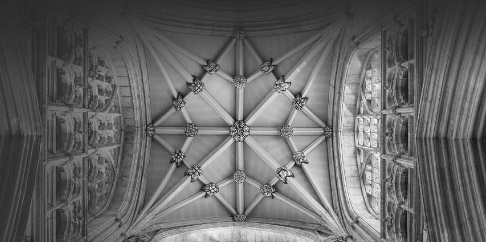
But – as we do that – we also have to try and find the briefest way of reminding those who have come through these great doors of even greater Good News, because this building was built to be a reminder in stone and glass of God’s ultimate Good News for a dark world, and if people come here and not notice something, no matter how tangential or small, about this, then we have failed in our mission.
And it’s not always easy – especially when the world feels such a very dark place. It’s not always easy knowing how you can do this, especially when everyone loves what is wrong or when everyone lies to [their] neighbours or when the wicked keep on strutting – which, of course, are phrases from a slightly more modern version of Psalm 12, which we heard sung at the start of this service.
Because there are times – really rather a lot of them at the moment – when we might find ourselves crying out “Help me, Lord, for there is not one godly man [or woman] left…”
So perhaps I should tell you about Paul – Paul, and his friend Barnabas – about whom we heard in the second lesson. They’ve just rocked up in Antioch on quite a challenging mission trip. Scroll up just a few verses to the start of that chapter of Acts, and you’ll find Paul has had to confront someone whom he has called a ‘son of the devil’ and an ‘enemy of all righteousness’. And yet, when asked to give a ‘word of exhortation for the people’, he still remains capable of talking about Good News.
But – actually – this evening I’d rather tell you about someone else – about someone I met yesterday morning here in the centre of York – about someone else who really knows what it means to give a word of exhortation to the people. And, indeed, because York is really quite a small city, I’m sure some of you will know her…
Her name is Laura, and she attends services here at the Minster with some regularity, although it was not at a service that I met her. Laura has studied law, and could be earning an impressive corporate salary as a solicitor – but she isn’t. She’s worked in the charity and safeguarding area, where she most certainly could have continued to have a regular desk job with a predictable salary – but she doesn’t any longer.
You may have come across her in the remarkable deli-cum-restaurant she owns less than five minutes from the west door, The Larder Club . I can tell you first hand that the coffee and chocolate brownies she serves are superb, and the rest of the grub looked pretty good as well. But if I was simply going to plug nice cafés in this lovely city, we all know there’d be a long list.
But the Larder Club reflects not just a passion for great food and coffee. The Larder Club is a remarkable social enterprise supporting the rehabilitation of women offenders who have suffered abuse and/or mental health issues. A social enterprise rooted out of Laura’s experiences in getting to know the inmates and the governor of HMP Askham Grange, and realizing that there was a group of people who had been immersed in bad news, both as victims and perpetrators – a group of people whose lives could most definitely be changed by access to Good News – access to training, placements and possible employment.
Of course, when people like Laura go down a road like this, it is often a vulnerable and unpredictable road that lacks the safety and security that other job possibilities might have offered her. And, as I discovered from the Reverend Richard Coles, who is also a huge fan of Laura and her ministry, rising high street rents mean that the Larder Club may not see the dawn of 2023, which would be a great tragedy not just for its customers but for the vulnerable people whose rehabilitation it has championed.
The risk, of course, makes Laura’s story all the more powerful, and it was hearing that story that made an already excellent brownie and cappuccino taste even better. And it was a reminder to me that one person – just one person – can make a difference and show the world Good News.
Because that’s really what it’s all about. Whoever wrote Psalm 12 could see the bad news all around, but nevertheless remained confident that the Lord ‘will help every one from him that swelleth against him’. But God can’t do it on his own. God calls us to work in partnership – which is why God has gathered us here this evening for Choral Evensong.
And so it is that the question that was put to Paul is now being put to us – “if you have any word of exhortation for the people, give it.” And if you need a bit of time to work out what your ‘word of exhortation might be’, you could do worse than pop into the Larder Club for a coffee, and, like me, be inspired how Laura answered that call, just like Paul, Barnabas, and the rest of the people of God before her. Amen.
Strive first for the Kingdom of God – The Very Revd Dean Dominic Barrington
Sermon Preached on Saturday 12 November 2022 during Evensong and Installation of the Very Reverend Dominic Barrington as 77th Dean of York
Preacher: Very Revd Dean Dominic Barrington
Title: Strive first for the Kingdom of God
Date: 12/11/22 3pm
Five or six years ago, when my elder son Benedict was around nine or ten, and he and his younger brother Linus were too young to walk to school on their own, Alison and I would accompany them on the fifteen-minute journey through our neighbourhood in Chicago. Benedict had realized that polite, intelligent conversation was a sign of maturity and adulthood, something good to which he aspired – but he hadn’t fully learned how to make this happen easily. And so, pretty much every morning, he’d turn to his mother or me as we left the house, and, with youthful eagerness demand, “So, Mum… so Dad, what do you want to talk about?”
Not being a great morning person, and having usually had only the one cup of coffee at that point in the day, it was often quite hard to find an answer that would satisfy him, and my usual response was to turn the question around by 180 degrees, and say, “So, Benedict – what do you want to talk about?” Good conversation is vital to healthy relationships, is vital to a flourishing society, is vital to the life of prayer, and of mission and ministry. But we have to know what we should be talking about.
Benedict would have got on well with the prophet Isaiah, from whom we heard just now. For he knew exactly what he wanted to talk about, and it did not always make for comfortable listening.
The world as he knew it was not in a good place. The neighbouring states were behaving foolishly and making very unwise political and military decisions. The regional super-power of Assyria was growing ever the more threatening and demanding, and the kingdom of Judah, in which Isaiah lived, was led by a king who was both stupid and evil, whose choices were predicated on bad decisions – on godless decisions – which the prophet could see would end in disaster. “So, Isaiah,” said God – “what do you want to talk about?”
And Isaiah’s response was to get people to focus on, to strive, for what Jesus would call the ‘kingdom of God’. The section of prophecy that was our first reading is the culmination of three chapters in which Isaiah is critiquing the fact that King Ahaz would rather trust a foreign king of highly dubious intentions that trust in the one God. And although the prophet could see that eventually all would be put right, he was crystal clear that in the short term, things were going to get worse – seriously worse.
We often read from Isaiah in Advent and Christmas, let alone hear some of these passages set to music by Handel in Messiah. But we should not forget that while Christians hear a great pre-echo of the coming of the Christ in his words, Isaiah’s own vocation was not trying to predict the long-term future. That is not, in this context, what prophetic means at all. Isaiah, and the other Hebrew prophets, their vocation was to talk about the present, and ask – no, demand – that people (and especially those in authority) paid heed to what God was calling God’s people to do in the world.
Of course, the great prophet wasn’t the only person who had something to say just now. “So, Jesus,” says God – “what do you want to talk about?”
And this afternoon, we find Jesus in the middle of the Sermon on the Mount, talking to us about how best we can seek out and serve the kingdom of God. Just as Isaiah was challenging the king, the religious leaders, and the peoples of Judah and Jerusalem – challenging them about their priorities, their choices and their behaviour, so Jesus is challenging the crowds who have begun to follow him – challenging them about just the same issues: priorities, choices, behaviour. Asking the crowds if they know what they should be talking about.
Telling them that it isn’t good enough to be talking about earthly treasures; telling them that talking about self-interest just does not cut it with God. Telling them that the only conversation worth having is talking about – and helping build – God’s kingdom and God’s righteousness.
At this relatively early point in Matthew’s gospel, Jesus’ audience is a local, rural audience from the communities dotted around the Sea of Galilee. But, as the gospel narrative makes plain, striving for the kingdom of God would lead Jesus into conflict with religious and secular leadership, until, on an ugly hillside outside a city wall, he ends up arms outstretched, dying on a wooden cross.
Dying, because he would not compromise in proclaiming the Good News of a love uniquely strong and uniquely universal. Dying, because he would not – could not – stop striving for the kingdom of God.
And here we are, 2000 years later, sitting in this breathtaking building, enjoying the pomp and circumstance, the tradition, the history, the legality which is deemed necessary to make a new dean. But I hope, in amongst all this ‘stuff’ – I hope that none of this is distracting us from the fact that God is saying to you and to me this afternoon just what God said to Isaiah and to Jesus: “So – what do you want to talk about?”
Because there’s just as much to talk about as there was when Isaiah and when Jesus were preaching. In the country from which I have just returned from living for seven years, many worry that democracy itself is under genuine threat, and that violence is becoming the normative way to engage in political debate. For most of this year, Ukraine has been despoiled by an evil and senseless war. The imminent World Cup is set to take place in a gulf state mired in human rights abuses. Israel has just returned to power the scandal-ridden Netanyahu whose re-election has only been made possible by an alliance with a party of unashamed racist and supremacist values.
In our own country, we have just lived through a period of unique political instability set in the context of significant inflation, a recession which might be the most severe on record, and rampant industrial unrest, even in sectors not normally given to strikes and the like. And even here, in this very country of North Yorkshire, food banks have, apparently, seen a 58% rise in demand this year, and nearly 16,000 children are thought to be living in poverty as we approach Christmas.
All of which suggests to me – and, I hope, to you – all of which suggests that there’s quite a bit more striving still to do if we are going to get anywhere near the Kingdom of God.
But, as Isaiah and as Jesus both knew very clearly, ultimately the news is Good News, because, ultimately, God has no other kind of news to offer the world. And that’s because the God whom we are gathered here to worship is not a God who wants to offer a superficial ‘quick fix’ to the challenges and problems which confront us, and which confronted Isaiah and which confronted Jesus.
As Sam Wells said in a recent Thought for the Day, “The God Christians see in Jesus is not a simplistic fixer but one who deeply shares our human predicament…”
Or, as Bill Vanstone said in the greatest hymn to be written last century, this is the God whose love is revealed in ‘nails and thorns’ – the God, ‘whose arms of love aching, spent, the world sustain’.
The great joy of becoming the 77th Dean of York is that I – and you – all of us – we have this great building on our side. York Minster has already been talking to the world about this God for hundreds of years and it will continue to do so for many hundreds more. This building is probably more eloquent than you or I can ever be about the God in whose honour and to whose praise it was built. But it needs us – it needs you and me – to work in partnership with it, if it is to talk properly and fully about the Kingdom of God to the many overlapping communities that it and that we are called to serve.
They tell me that now I’ve arrived – now – incredibly – that I am your Dean, they tell me that many people will want to come and talk to me about all sorts of things. About money, about buildings, about tourism, about church politics, about the service times on a Sunday morning, and doubtless about a whole host of other things that I am yet to discover.
And I guess that we can talk about all that. But let’s make sure – let’s make really really sure – that none of that gets in the way of what God is hoping that we will talk about. So, let’s strive first for the kingdom of God. And then – and actually, it will only be then – that all these other things will be given to us as well. Amen.
Lost Causes? – The Reverend Canon Peter Moger (Precentor)
The Reverend Canon Peter Moger (Precentor/Acting Dean)
Sunday 28 October 2018 10am Sung Eucharist
(St Jude) [458]
In the name of the living God who is Father, Son and Holy Spirit.
A few years ago, Heather and I were taking a short break on the island of Iona off the West Coast of Scotland. It’s a favourite place of ours, as those who came on the pilgrimage earlier this year will know. On this occasion we were walking to the south of the island along one of the beaches. It was a windy day and the wind was blowing sand into our faces. Heather got some sand in her eye and took out her contact lens to clean it. Along came another gust of wind and – you’ve guessed it – the lens was gone. There we were, miles from anywhere with no replacement lens, and no glasses either! And so we started to search.
I don’t know whether you’ve ever tried looking for a contact lens on a beach – don’t! It’s one of the most frustrating things imaginable. 45 minutes later, we were still looking. It seemed a totally lost cause. And so we prayed to St Jude, who is the patron saint of lost causes. And in a few minutes, we found the missing lens, sitting innocently on the sand.
Today is the feast of St Simon and St Jude. They were among the 12 Apostles called by Jesus and are named in the Gospels of Matthew, Mark and Luke. Simon was known as Simon the Zealot – presumably because he belonged to a resistance movement of the time which opposed the Roman occupying forces. Jude (or Judas) is described by Luke as ‘son of James’ – though the Letter of Jude calls him the ‘brother of James’. It’s likely that Jude is the same person as Thaddaeus. Simon and Jude are celebrated together, on the same day, because there’s a tradition that they both evangelised in Mesopotamia.
Because Jude’s name is similar to that of Judas Iscariot – who betrayed Jesus – Christians tended not to pray through him. It seems likely that he then became a sort of ‘last resort’ when all else had failed. Hence, Jude became known as the patron saint of lost causes.
Well, it certainly worked for us in the case of the contact lens. But is there really such a thing as a lost cause?
Some Christians have a tendency to say – if something doesn’t quite work out the way we thought it should – ‘ah, it’s all part of God’s plan.’ I often feel this is one of the worst of religious platitudes. Most of us will have had situations in our lives when things haven’t necessarily gone the way we were hoping (or expecting), and on looking back, we can sometimes see how, over time, something else happened which in the end proved to be a better option. Hindsight is a great thing. But did God really plan it like that? Are our lives mapped out to the nth degree, and is our job as faithful Christians really to try and stick absolutely to God’s plan – whatever that might be – making sure we don’t put a foot wrong?
I recently watched again the film About Time in which Tim, a young man, learns that he has the ability to travel back in time, and therefore to re-live episodes in his life – changing his past so as to improve his own future and that of others. The plot centres around his relationship with Mary, and by continually re-visiting encounters from the past, he is able to engineer events so that they end up together. It’s great entertainment – but it does beg a number of questions:
‘Is there really a single right path?’
‘If we ‘go wrong’ – can we put things right, or are we a lost cause?
And what, if anything, does God have to do with it?
If we look at the Bible, we see two strands of thinking there. On the one hand is the omniscience of God. God is presented as all-seeing and all-knowing. The writer of Psalm 139 muses:
O Lord, you have searched me out and known me;
you know my sitting down and my rising up;
you discern my thoughts from afar.
You mark out my journeys and my resting place
and are acquainted with all my ways.
For there is not a word on my tongue,
but you, O Lord, know it altogether. (Ps 139.1-3)
Jeremiah speaks of God’s plans to those who had been taken into exile from Jerusalem to Babylon:
Surely I know the plans I have for you, says the Lord, plans for your welfare and not for harm, to give you a future with hope. (Jeremiah 29.11)
On the other hand, is the metaphor of walking with God. This uses imagery such as paths and ways. The Psalmist prays:
Make me to know your ways, O Lord,
and teach me your paths. (Ps 25.3)
The early Christians spoke of their new-found faith as ‘the Way’. When Paul (or Saul) was still a persecutor of Christians, he
went to the high priest and asked him for letters to the synagogues at Damascus, so that if he found any who belonged to the Way, men or women, he might bring them bound to Jerusalem. (Acts 9.2)
Later in Acts, Luke records that the Roman governor Felix was ‘rather well informed about the Way’ (24.22). This resonates well with the Hebrew Scriptures. Isaiah reassures the people of God by saying:
When you turn to the right or when you turn to the left, your ears shall hear a word behind you, saying, ‘This is the way; walk in it.’ (30.21)
So, on the one hand, an all-knowing God with a plan; and on the other a God with whom we walk in a personal relationship.
So does God have a plan for you and for me? The danger of swallowing this wholesale is that we can easily be convinced that if we depart from it, everything becomes a lost cause, and ultimately we become a lost cause. And so we can be driven either to excessive caution or bleak despair; or we simply adopt an attitude of resignation in which everything must happen because it’s God’s will.
One of the central beliefs of Christian faith is that God has given human beings free will. That sometimes means that while we might know exactly what we ought to do – how we ought to behave – we don’t. Hence the heartfelt cry of the BCP confession:
We have left undone those things which we ought to have done; and we have done those things which we ought not to have done; and there is no health in us.
But our free will is a gift from God – it is what distinguishes us as human beings, and is one of the marks of humanity that derives from the fact that we bear the image of God. God expects us to use our free will: to think about our actions, but above all, to continue walking with God. God has, not a plan for us, but a purpose – and that purpose is that we keep on walking in the Way. As we walk, we hope and we pray that we will stick close to God, as in Psalm 119:
Blessed are those that are undefiled in the way :
and walk in the law of the Lord. (Ps 119.1)
Some of the time, we’re good at this. We keep in step with God; we’re aware of his being with us at all times. At other times we’re not: we’re more like the proverbial sheep who have gone astray – each to our own way (Isa 53.6).
But when we go our own way, and stray from the Way, all is not lost – we are never a lost cause. God is still there, because Jesus – through whom we know God – is himself the Way.
The final chapters of the Gospel of John include some of the profoundest teaching about the closeness of this relationship. Jesus talks to the disciples about being the vine, and them the branches, with God the Father as the vine-dresser ensuring that there is good fruit. These are reassuring words for all of us. They speak of us being ‘rooted, grafted and built’ into the vine. We are to ‘abide in him’ as he abides in us.
St Jude himself asked Jesus a question:
‘Lord, how is it that you will reveal yourself to us….,?’ Jesus answered him, ‘Those who love me will keep my word, and my Father will love them, and we will come to them and make our home with them. (John 14.22-23)
Earlier I quoted from Psalm 139. The Roman Catholic priest and hymnwriter Brian Foley re-worked that Psalm as a hymn. I leave us with his words:
There is no moment of my life,
No place where I may go,
No action which God does not see,
No thought he does not know.
Before I speak, my words are known,
And all that I decide,
To come or go: God knows my choice,
And makes himself my guide.
Stay up to date with York Minster
- Event alerts
- Seasonal services
- Behind the scenes features
- Latest Minster-inspired gifts