Assumption of the Blessed Virgin Mary – The Reverend Dr. Rowan Williams
Revelation 11:19- 12:6, 10 Luke 1: 46-55
Solemn Eucharist – Wednesday 15 August
At my primary school, we had weekly hymn practice. Our favourite hymn, which we requested week after week, was one which you probably have to be a certain age to remember: When a knight won his spurs in the stories of old. It goes on to describe some of the clichés of chivalry. Knights are gallant and bold- and they kill dragons. Now, as a Welsh person I’ve always rather enjoyed the fact that our first reading from Revelation contains dragons- and red dragons at that. In the great East Window of the Minster above my head, the same red dragon appears alongside a monster with seven heads. Neither of them look particularly scary; but even as a Welsh person, I have to admit that the dragon of Revelation is meant to be a symbol of evil, waiting to destroy the woman with the crown of stars and her child.
The woman and her child are never named in Revelation: but their significance is obviously intended as a reference to Jesus and his mother Mary. There is so much about Revelation which makes it as easy to dismiss as fairytales and legends. If we no longer believe in knights, dragons and monsters, why on earth should we still believe in the rest of it- angels, heaven, God? Jan Struther’s hymn, which I learnt when I was seven, spells out why. The knights are all gone and the dragons are dead- but the dragons of anger and the ogres of greed still exist and still need to be destroyed: in our Church, in our world, in our own lives.
We can no longer afford to believe in romantic visions of the past, but there is still a role for faith in the battle between good and evil. And Mary, the mother of Jesus whom we celebrate today, helps us to root that battle- and our faith- firmly in the real world instead of a world of fantasy. Her song, the Magnificat- which was our Gospel reading and which we sing here every day at Evensong- is a rallying cry for the transformation of the world. A young woman, whose whole place in society is already marginal because of her gender and made even more vulnerable by unexpected pregnancy, sings with absolute confidence of a God who confounds expectation. Mary names the dragons of her own day, and of ours: poverty, power imbalance, injustice, hunger- and speaks of God’s utter commitment to their destruction. So Mary’s song is not a wistful ‘if only the Kingdom were like this’. It’s a profound and radical call to put our faith into action, to build the Kingdom.
A great deal of nonsense has attached itself to the figure of Mary over the centuries. She sums up the ambivalence of a Church which took six centuries to declare officially that women had souls, and another six centuries after that to begin to take seriously the theological implications of Jesus’ humanity. That debate lies at the heart of the confusion about what exactly it is that we celebrate today. If Mary is an ordinary human being like the rest of us, her human death is not a matter for shame, to be explained away by theology. But if Elijah the prophet can be taken away into heaven at the end of his ministry, why not Mary at the end of hers? The very point of Mary is that she is indeed human; for if Mary isn’t human then nor is Jesus, and if Jesus is not human then we are not saved. But Mary’s existence as a human physical woman has been problematic too. Mary’s virginity and her motherhood have been used down the centuries to limit options for women: there’s still a kind of silence about those of us who are neither of those things, as if we didn’t or shouldn’t exist. When I was seven and singing When a knight won his spurs in assembly, my brother could join the church choir but I couldn’t. So it’s been a delight to sing services in the Minster this week with the girls’ choir from St Peter’s Wolverhampton, to show them that there are no reasons why one of them, can’t go on to preach, or to direct music in a cathedral- or anything else that they are called to do.
But not all the dragons are dead yet. We still live in a world where senior politicians can belittle women who choose to dress a certain way- let’s not forget that Mary wore a headscarf. We still live in a culture which thinks it can tell women (and men too, for that matter) what to eat, how to look, how to behave, who to go out with. We still live in a world where #MeToo needed to happen. The radical vision of the Magnificat is not a song for women. It’s a song by a woman, which has become the song of every Christian who shares that vision of a better world- where the hungry are fed and the powerless enabled, where wealth and influence are equally distributed, and nobody is made more perfectly in the image of God than anyone else. Mary’s song is not a fantasy or a fairytale. The dragons of anger and ogres of greed are as much of a threat now as they ever were. But, as the hymn points out, it cannot be left to some mythical knight in shining armour to defeat them.
Mary’s story, Mary’s song, is ours too: an ordinary human being, called into relationship with God, called to work with God to bring about the Kingdom on earth. It won’t just happen. Except that we know that it is already happening. The dragon did not win. The woman and her child survive. And Mary’s song echoes down the generations, and outside all time: My soul magnifies the Lord, and my spirit rejoices in God my Saviour. From henceforth, all generations will call me blessed.
First Sunday after Trinity – The Reverend Dr. Rowan Williams
The Reverend Dr. Rowan Williams
First Sunday after Trinity – June 3, 2018
2 Corinthians 4: 5-12 Mark 2: 23- 3:6
Do you remember, during the last election, someone asked Theresa May in an interview what was the naughtiest thing she’d ever done ? (I gather this question is now also put to those who are about to become bishops…) After a slightly surprised pause, Mrs May said that she’d got into trouble as a child for running through fields of wheat near her home. She didn’t say whether she had compounded her crime by doing it on the Sabbath, but I do wonder whether perhaps today’s Gospel was at the back of her mind.
Of course it’s not walking through cornfields on the Sabbath that so upsets the religious authorities about Jesus. It’s not even the fact that he and his good Jewish disciples break the Sabbath by picking corn to eat- technically, that counts as work, so it’s forbidden; but it’s a minor infraction compared with reinterpreting the entire purpose of the law. And that’s what Jesus does here. The Sabbath was made for human beings, he points out: not the other way round. Everyone should have one day of rest per week, to remind us that God is the centre of life rather than ourselves, that we aren’t actually indispensable, and that workaholism isn’t the same as holiness- and yes, I’m preaching to myself here, too. The journalist A.J. Jacobs, in his book A Year of Living Biblically, tries to keep the Sabbath law literally and finds it really hard- not least because you spend so much time worrying about what you can and can’t do that you don’t have much concentration left for God.
But Jesus doesn’t leave it there. He heals a man with a withered arm. What better day than the Sabbath, you might think, to restore someone on the outside edge of society to a full relationship with his community and with God? What better witness could there be to the loving power of God? If the Pharisees object, they will look like monsters: not just inflexible in their interpretation of the law, but actively prolonging suffering for the sake of principle. And they know that. But they can’t be seen to back down. So they say nothing- but they begin to look for an opportunity to accuse Jesus of more than mere words. And sure enough, he gives it to them.
‘Is it lawful to do good or to do harm on the Sabbath, to save life or to kill?’
This is no longer mere rule-breaking. This is a massive ethical and moral escalation. And by posing this particular challenge, Jesus is using his own life as the stake, to force into the open the logical absurdity of a moral absolute. If the things you cannot do on the Sabbath become more central to our understanding of God than the things that demonstrate our freedom and wholeness in God, something has gone seriously wrong with our moral compass; just as it had with the Pharisees. For their response to Jesus was not to confront the logical flaws in a rule-based interpretation of religion which prevent you from healing in the name of God on the wrong day; it was to destroy the person who pointed out their mistaken priorities. The law of God is made to be a framework for our lives, not a straitjacket. We do need structures: we need an agreed ethical and moral code. But the point of it is not the law itself: it is the life which the law makes possible. I have come that you may have life, and have it in abundance, promises Jesus in the Gospel of John.
And have it in abundance. For life itself, in the sense of mere existence, isn’t the point either. For much of the last two weeks, much of my pastoral and theological conversation has been taken up with the recent Irish referendum on abortion. A couple of days ago I celebrated Communion at a church in York on the feast of the Visitation. And as we heard the Gospel for that day, two things struck me with equal force. The meeting of Mary and Elizabeth, both of them unexpectedly pregnant, is the only example I can think of, of a Bible story in which the protagonists are two women, equal in standing, with no male characters making decisions for them or telling them what to do. It is the women’s own voices we hear, with no men narrating events from a male perspective. Theirs is a mutual recognition, a mutual empowering. Women’s ability to make decisions about their own bodies and control what happens to them is at the heart of the story. But… so too is the fact that it is the unborn John the Baptist who, moving in his mother’s womb, becomes the first witness to Jesus; and the unborn Jesus whose potential is made tangible in this moment. How to hold these insights together? How to rejoice at what I do, personally, believe to be a good and right decision on the part of the Irish people; and simultaeously recognise the pain of those who profoundly disagree?
This is, as the Roman Catholic theologian Tina Beattie acknlowdged, a moment of extraordinary moral complexity, which deserves to be met not with posturing but with maturity and seriousness. Life and death are huge matters. The fact that we can reflect on their meaning and their purpose is itself a gift. For life is not, in the end, a right. And mere existence is not always to be celebrated, never mind equated with having life in abundance. As Tina Beattie points out, we do nobody any favours if we reduce debates about the beginning of life- or the end, for that matter- to emotive language about murder and killing. Instead, we have the opportunity to ask ourselves what we want life to mean, what we hope it can mean- and to face the fact that quality of life is as important as existence itself.
Choices are not an end in themselves. They have consequences, and moral maturity means learning to live with them. Laws, whether secular or religious in inspiration, can and do change as our understanding of the human condition changes. God’s will for us, is, unmistakeably, pro-life; but in its fullest, most abundant sense, not in a legalistic one. Male, female, or transgendered, we each of us ‘carry in our bodies the death of Christ’, as the second letter to the Corinthians reminded us this morning. In other words, we are preganant with that death, impronted with it in our very being. But out of that death, let us never forget, came forth life- resurrected, glorious and joyful. The one makes no sense without the other. ‘Death is at work in us, but life in you’.
We were not made for legalistic wrangling, but for the loving purposes of God. Living up to that is difficult, because it requires us to think and act with real moral maturity, and respect the consequences of our choices. No rulebook yet devised has enough nuance to cover ever possible situation: which is why it is so important that we do not treat the Bible, or the Church, as if that’s what they are. Instead they are mirrors, held up to us, to show what life in abundance might look like, and how it might feel to live it.
And if we run through a few cornfields on the way, I really don’t think God’s going to mind too much.
The Great East Window Returns – Very Revd Keith Jones (Dean Emeritus)
Very Revd Keith Jones (Dean Emeritus)
Thursday 17 May 2018 – Evensong 5.15pm
For York Minster
Learning and skill, and each to a high degree, have made a right royal marriage in this restoration of the east front of the Minster. Like the whole Minster, this is a handmade masterpiece. Human hands have been cherishing the magnesian limestone and the glass and lead. Especially in these last years, men and women have been learning their craft on it and seasoned carvers have spent many hours getting intricate details perfect. Read the book! They have been as imaginative and accomplished as ever they were. Huge pinnacles have been set out and raised anew. Bowing walls have been made straight. Cracked and sometimes jumbled glass has been rendered lucid and firm. Well-meant botches in the past have been patiently corrected. The most careful balance has been made to capture the original achievement of John Thornton’s great work of 1408, but using the technology of today so that the trained eye can see how new work enhances the old. In making difficult decisions the Advisory Group for the window has weighed evidence, pondered history, and been profoundly glad of the quality of the experts at hand. And there it is. From the work of 1408 we know of hardly anyone’s name except John Thornton, our Michelangelo of glass. Today though we can name a host of people of whom we are proud. For they remind us that skills have not died, that here tradition is creative and living, and that here human handiwork has done such things as John Ruskin would rejoice in.
The programme of work on the Minster has to go on. There is always a next phase. Scaffolding is a sign that the Dean and Chapter are vigilant still in the care of this miraculous place. All the same, the completion of the east window is a special moment. For this window draws together the whole accomplishment of the Minster. York Minster is literally the most imperial of English cathedrals. For centuries its magnificence showed that the Christian Gospel was in no way diminished at the limits of the known world. This place proclaimed its meaning straight out, Yorkshire fashion. This, says the Minster, is how the truth is, even to the ends of the earth. This is the meaning of it all. Hear, and see. Shyness is not one of York Minster’s virtues.
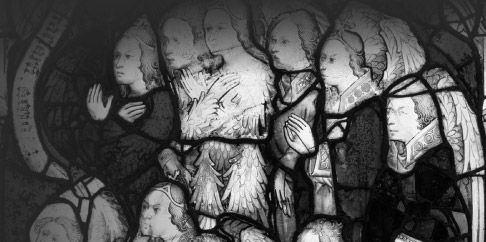
See what they hoisted into the air here! They took as their theme the beginning and the end of all things: nothing less. To do it, they turned to the most reliable history of time that they could trust: the Old and New Testaments, the history of the works of God from the first utterance of the meaningful Word, the Logos. So at the summit of the window is the benign but majestic utterer of that Word, depicted as a bearded man, all-Wise. And the creation streams in solidifying light through the angelic hosts to the panels where we see light and darkness being divided and the world being made. Then the panels trace the earliest legends of humanity in scene after scene. Nearer to us, with startling simplicity the story moves into the painful chaos of human history. Then it breaks off abruptly, as history keeps on doing, in the miserable upset of Absalom’s rebellion. And then the window shows us the visions of finality, when the children of time and the things of time are confronted by the shattering justice and unexpected mercy of that same God as portrayed for us in that charter for dreamers and imaginers, the book of Revelation.
All this ultimate narrative our ancestors lifted to catch the light and the winds of Yorkshire. Of course, in terms of sheer information about the world the people of the 15th century suffered from a huge information deficit. But they held this right conviction: that it is God who makes sense of this life and this world. That for all our human chaos, the beginning and the end of this creation are God’s. And when you come into York Minster, and most of all when you are part of its worship, you are surrounded by a world made gracious and ordered by these perfect arcades. We are drawn into the drama of it as we walk through its spaces. And as we ascend to the heart of the building, we bring our lives into the place where God is most clearly shown to us, and the music and the incense surround us, and the bread and the wine convey God’s very self to us, in the light of that translucent wall that closes the horizon ahead. We feel ourselves transfigured.
When we are showing the Minster to others, we should not speak of the builders of the Minster as them: think of them as us, rather, even though of another time. The Minster belongs to our national civilisation, expresses the beliefs of many centuries and is sustained by the living chain of human life. The stonemasons and glaziers of today, yes and the fundraisers and interpreters and administrators of today, and all who wish to identify as the people of today’s Minster are in unbroken continuation across the years. Apart from a regrettable but short disruption in the 17th century and the odd fire or plague, no long hiatus has occurred in the Minster’s life; chapters – even deans – come and go. The skilled craftsmen work generation on generation. Human beings, forming the One Holy Catholic and Apostolic Church have gone on drawing inspiration from such places as this Minster and keeping it standing. As we affirm the creed day by day we of our generation turn towards that easterly wall of stone and glass; towards the rising sun, the resurrection source, from which God comes to meet us whether it’s 1408 or 2018.
Yes, the Minster says to us, be reassured. Your lives are meaningful, because here is God. York Minster will not have it that life is random, and creation accidental as is the widespread fashion these days. Believe that if you like, but put up with the fact that we won’t have it. Our world may be in all kinds of mess, and the threats to it seem never to end. But here we declare our hope. The great east window tells us we are not to waste time unduly entertaining the thought that we may be deluded. When things are bad, Jesus said “look up, and lift up your heads; for your redemption draweth nigh.” (Luke 21, verse 28)
These days I find myself very often with the people of the l’Arche community which has a house only yards away from my home in Ipswich. We are people with and without learning disabilities, of various nationalities and Christian traditions. Some among us are unable to speak. David, for example, makes many unfamiliar noises while we sing and pray together. It is perhaps the opposite in splendour from York Minster, our simple holding hands and singing choruses; Rowland’s guitar rather than the Minster organ. The noise we make together is pretty fearful if you stop singing to listen. But In God’s sight we are every bit as prized and glorious, and one of David’s sounds as we pray is unmistakeably “Amen”. Amen he says. Amen.
And that is York Minster’s great word, which this window declares. In David’s Amen, that So be it, the simple daily acts of love and service by the hands of people who need one another is at one with the eastern climax of York Minster. “Amen!” say David and the east window of York. To all that has been, to all that is to come, the Alpha and the Omega: Amen.
Keith Jones
Dean emeritus of York
I am sending upon you what my Father promised – Reverend Dr. Rowan Williams
Reverend Dr. Rowan Williams
Ascension Day 10 May 2018 – 5.15pm Eucharist
Daniel 7:9-14 Acts 1: 4-11 Luke 24: 44-end
‘See, I am sending upon you what my Father promised; so stay here in the city, until you are clothed with power from on high’ (Luke 24:49)
Some of the Minster community are spending this week on the Scottish island of Iona, whose abbey has been a site of Christian prayer and pilgrimage for fifteen centuries. It was the 20th-century founder of the modern Iona Community, a Church of Scotland minister named George MacLeod, who said of the Ascension: ‘There is a human being in heaven; one of us has made it’.
One of us. Not one like us: not ‘one like a human being’, as the prophet Daniel put it, but a real human being: a real human being who is also God. We’ve been trying to get our heads round the mysterious truth of Jesus’ identity since even before St Columba first arrived on Iona, in the middle of the 6th century. And the Ascension marks a key moment in our understanding of that identity. Early this morning, as we do every Ascension Day, members of the chaplaincies of both York’s universities climbed the Minster tower, and my colleague Kevin said to the assembled students that Ascension is Jesus’ graduation: the fulfilment of both his humanity and his divinity.
We use the language of ascending and descending- up to heaven, down to earth- as a way of trying to make sense of our feeling that there is a distance (maybe even a separation) between us and God: as if we belong here, and God there. Jesus forces us to rethink that idea. For he is both here and there; both with God and with us; both then and now.
All the ways we have of understanding how time and space work are simply too small to comprehend how God can be both human and divine. We’re confronted with the same problem at the other end of the liturgical year: Ascension and Advent are opposite sides of the same coin. At Advent, we experience a similar knot in our linear understanding of time: we await the arrival of a baby who is simultaneously timeless, present in creation from the beginning of all time; and fixed in human history in first-century Palestine; and eternally present as we await the fulfilment of all time. At Ascension, we see that just as God transcends our understanding of time- past, present and future- so too God transcends our understanding of space- up and down, here and there. There is no division between heaven and earth. God is, was, and ever shall be here. God is, was, and ever shall be one of us: from the beginning of time to its end.
Jesus tells his disciples to ‘stay here in the city until you are clothed with power on high’. There’s that spatial language again. For it is here in the city- this city and every city, the here and now where we live, work, study and rest, among other human beings like ourselves- that we are to work out what it means to be made in the image of God, for our humanity to be transformed by sharing in divinity. It is here, and now, that we are to build the Kingdom and live out the truth of God, until we discover for ourselves what is beyond this life, beyond our current capacity to imagine or comprehend.
The disciples of Jesus do not know how they will manage without him. They do not yet know what they can do; and they do not yet realise what it will cost them to do it. But their task is not to wait for Jesus to return at the end of time before they act. It is to begin the work now of transforming the world we live in into the kingdom of heaven. It is not that God belongs there and we belong here. Quite the opposite. There is a human being in heaven: and because there is one, wherever human beings are is also, already, touched with the divine.
‘Why do you stand looking up into heaven?’ It is all around you. There is a human being in heaven. The whole world belongs to God, across every boundary of time or space: and it is here in the city that we are to find him.
See that you love one another – Reverend Dr. Rowan Williams
Reverend Dr. Rowan Williams
6 May 2018 – 4.00pm Evensong
Song of Solomon 4:16- 5:2, 8: 6-7 Revelation 3: 14-end
When my grandmother died, we found her diary. She began it just after the Second World War; so that my dad, who was six when his father’s ship was torpedoed by a German U-boat, would have something to remember him by. She wrote it all down: how they met in a Baptist youth group when she was seventeen, married against the wishes of her father, and were separated by war when my dad was still only a toddler. She obviously began it wanting him to know the whole story: but as she revisited it all, somehow it became too personal to share. She described in terrible detail the arrival of the telegram, the disbelief, the grief and numbness- and then, for decades, there was only silence.
My grandmother lived for another 57 years, but she never married again, and she never did bring herself to talk to my dad about his father; and a great emotional rift opened up between them as a result. She hoped he would one day read the diary and understand- but it was too late. My grandfather’s body was never found, but my grandmother’s grave is marked with both their names, and a quote from the Song of Songs: Many waters cannot quench love, neither can the floods drown it. It was believing that, for 57 years, which kept her going.
What the Song of Songs, or Song of Solomon, is doing in the Bible at all is open to question. It’s the only book in the ordinary canon of Scripture which never mentions God. Scholars have tried to explain it away by understanding it as an allegory; God’s love for his people, or Christ’s love for his church. In mediaeval times it was hugely popular among preachers, and also among female religious and mystics, who perhaps saw themselves reflected in it as nowhere else in Scripture. The woman in the Song of Songs is neither a virgin, nor a mother, nor a prostitute, so she escapes all the usual stereotypes attached to her gender: she is allowed to express her desire in unambiguously erotic language, as indeed is the man. ‘Love one another fervently’- yes, certainly; but ‘with a pure heart’? Not so much. For this isn’t an allegory of desire: it’s the real thing. Passion fierce as the grave, love strong as death, raging flames: if this just sounds like a collection of Mills and Boon clichés, well, read the rest of the book and it doesn’t leave much to the imagination.
There is no doubt that the Song of Songs does work as an allegory if you want it to, because this is precisely what desire feels like. There is no other book in Scripture which so graphically describes what it feels like to want- whether what you want is another person, or God; or for that matter a career, a vocation, or music, or safety, or death. But the Song isn’t just about the wanting; it is equally graphic about the end of the search. Satisfaction. Consummation. No wonder it had to be explained away as theological allegory; for the Christians who decided this book did belong in the canon of Scripture had also inherited a terrible ambivalence about anything to do with bodies or sexuality. Love is OK as long as it is kept pure and spiritual: agape or philadelphia are permissible, but eros becomes steadily more and more suspect. We still know what it is to want, but we are taught that we shouldn’t want certain things- or certain people. Sex itself becomes theologised into something shameful, something less than pure; until we reach the point where God is supposed to satisfy all our needs, so how dare we still want?
Of course that’s not the whole picture. There have been brave theologians down the centuries who have let the Song speak on its own terms. The experience of desire, including sexual desire, is enormously powerful in helping us to understand different ways in which it might be true that God loves us; different ways in which we might feel empty or incomplete without God. If we are lucky enough to know human love in our own lives, we may well find in it a window on to the love of God; for those of us who do not, perhaps it is the image of the wanting and searching that speaks most powerfully not just of what it is to want, but also to be wanted.
‘If one offered all the wealth of one’s house for love, it would be utterly scorned’ (Song of Songs 8:7) What is there for which you would give everything you had? Another person? A job? An idea, a principle? This vision of love, potently physical and embodied as it is, is not all about us and our own feelings: it is also about the separate reality of the objects of our love and desire. If we turn the people we love into mere extensions of ourselves, projections of our own feelings, that is not reality. For they too have feelings, experiences and desires which are just as powerful as ours- and when the two don’t match up, the result can be extraordinarily painful.
When my grandmother died, her brother said to me that he’d often wondered over the years what would have happened if my grandfather had survived the war and come home. We’ll never know. The vision of him in her diaries is so clearly idealised that it’s impossible to get a sense of who he really was. But the sense of s passion fierce as the grave remains. The waters in which he died did not quench love, but they ended up costing my dad more in emotional terms than he could afford.
Love is not for the faint-hearted. That’s the charge laid against the church in Laodicea, in our second reading. They are too lukewarm, too dispassionate. There may be purity in their hearts, but there is no fervour. God’s love demands more. It is uncompromising, bringing with it ‘reproof and discipline’ for those who do not give everything. But it is not self-indulgent. For God’s love treats us as absolutely real. God wants our fulfilment, our satisfaction and completion. God wants us to be who we are, who we are called to be; complete with our unruly bodies and our messy desires. Whether it is a person or a principle we want most, to love them- with a pure heart, fervently- is the most Godlike thing we could ever do.
Stay up to date with York Minster
- Event alerts
- Seasonal services
- Behind the scenes features
- Latest Minster-inspired gifts