

Another Lost Man
Gracious God give peace to all in this house, to travelers and hosts. In our hearts, speak of your kingdom, for the harvest is plentiful and we rejoice to be your laborers. Amen.
Walking along a Somerset path, in a glass case where one usually finds a map, we discovered beautiful calligraphy with these words from the poet William Butler Yeats (1865-1939).
“Had I the Heavens’ embroidered cloths, / Enwrought with golden and silver light, / The blue and the dim and the dark cloths / Of night and light and the half light, / I would spread the cloths under your feet: / But I, being poor, have only my dreams; / I have spread my dreams under your feet: / Tread softly because you tread on my dreams.”[1]
My name is Malcolm Young and I am from Grace Cathedral in San Francisco, California. To share our dreams is to share the most vulnerable part of ourselves. This is hard to do with someone we have only just met. But let me tell you something that not many people know about me. I look and sound American, but inside I feel both American and English. My mother grew up in Yorkshire, and as a child our house felt like a little bit of Britain. So arriving here is like coming home for me, except that no one else sees this as my home.
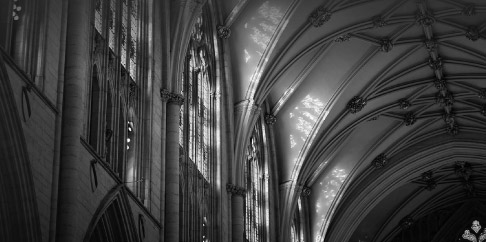
Today in this ancient and holy cathedral I would like to share some dreams, dreams about the kingdom of God. Like the seventy disciples in today’s gospel, my wife Heidi and I came to England in June as a pair, sometimes with our adult daughter Melia, but always traveling light. We have visited dozens of cathedrals and churches, spent time with family and made many new friends. The people we met have been frank with us about the challenges faced both by the church and by society in general.
We will not be together for long so let me describe what it feels like when the kingdom of God comes near. This sermon comes in two chapters. The first concerns the challenges of living as if God’s kingdom is real. And the second is about the way that joy from God still manages to finds us.
1. How hard it is to live in God’s kingdom even though we were made for it. Everywhere we traveled the headlines scrolled silently under the BBC news television broadcasts. These messages reminded us how many people are being killed in Gaza and Ukraine each week, of bombing campaigns and an escalating war in Iran, terrible violence and punishment, rising housing costs and despair. Life feels hard for many people and our personal philosophy of life can make our suffering worse.[2]
In 1938 C.S. Lewis published a science fiction book called Out of the Silent Planet. The technology seems hopelessly outdated but I was surprised how contemporary its critique of modern materialism still feels. A Cambridge University philologist named Elwin Ransom is drugged and kidnapped by an old school acquaintance, and a scientist named Dr. Weston. He awakes to find himself on a space ship and overhears their plans to trade him as a kind of human sacrifice to the inhabitants of another planet in exchange for gold.
After arriving on the distant planet Ransom escapes and learns the language shared by the three forms of intelligent life there. He finds out that each planet has a kind of spiritual ruler and that earth is called “the Silent Planet” because its ruler has become “bent” or evil and that this has resulted in earth being cut off from the other planets and at war with itself.
Near the end of the book the scientist/kidnapper Weston speaks to the ruler of the distant planet (Oyarsa) in words that sound like they could have been spoken by the SpaceX CEO Elon Musk.[3] He says, “I bear on my shoulders the destiny of the human race… Life is greater than any system of morality; her claims are absolute… Life… has broken down all obstacles… and to-day in her highest form – civilized man – and in me as his representative, she presses forward to that interplanetary leap which will, perhaps, place her forever beyond the reach of death.”
The angel-like ruler of that distant world replies that life is meaningless without love and Weston does not love any actual person or even his own species. Weston just dedicates himself to an abstraction and that this arises out of a relentless fear of death among human beings.
This is what Christians mean by the word sin. Something in us is broken and leads to terrible and seemingly inescapable suffering. It is the reason for the BBC headlines, for the signs I see on bridges here that say “There is hope. Talk to someone,” or “Whatever you’re going through, you can talk to us.” There is an undercurrent of despair that cannot be denied.
In Bath we saw a new play by David Hare called “Grace Pervades” about two of the greatest actors of the Victorian era Ellen Terry and Henry Irving (played by Ralph Fiennes). Irving owned the Lyceum Theatre company on Charing Cross Road in London. We hear the story in part through the narratives of Ellen Terry’s daughter, who is an underappreciated but prolific theatre director producing 150 plays herself. And Terry’s son who is portrayed as a failed dramatist, a theorist, a self-proclaimed genius who imagines a future “theatre without actors… without words…” He cannot make do anything because any action will limit what he could do.
In short the two principal women in the play, Ellen and her daughter, are well-grounded, warm, empathetic, thoughtful, wise and secure. The two men are melodramatic, self-absorbed, with foolish ideas which cannot be easily corrected by the people around them. The difference between them seems to be that, although reluctant, Henry ultimately listens to Ellen. As Ellen approaches death in her Kent country home she remembers her tour to America. She says, “We went to America. They understood us. The people were so warm… warm but a little lost.”
After the play my wife Heidi was darting through the lobby so quickly and I foolishly asked her if she knew where she was going. Immediately behind me a woman said in clear loud German, “Ein andere verloren Mann.” “Another lost man.” She is right. I am lost in just the way those characters are. I’m wrapped up in my own fears and dramas, often cut off from the very sources of help that God is sending to me. I am that lost sheep that God continues to seek out.
I think this is the reason God sends us in pairs. It is so hard to hold onto the truth and we need another person to help remind us of it. Churches are places where we meet these friends who show us how we are all part of God’s kingdom of love.
2. At Southwark Cathedral we met a couple in their late eighties named John and Djemila Cope. Later they took us to lunch and we learned their stories. John had a distinguished career in parliament. Djemila’s great-grandfather was Horatio Spafford (1828-1888) a lawyer who had invested heavily in real estate which was destroyed by the Chicago fire in 1871. Although the family home was spared, nearly everything else they owned was lost. They had planned to tour Britain as a family, but Spafford was working on plans for re-building the city and the family went ahead without him.
Then on November 22, 1873 the family’s steamship Ville du Havre was struck by another ship. It sank in just 12 minutes killing 226 people including all four of the Spafford’s daughters. Their mother miraculously survived floating on a piece of timber. Her telegram from Dublin said only two words, “Saved alone.”
Horatio took the next ship to go and comfort Anne. At a certain point the captain took him aside to tell him that they had reached the place where his daughters had lost their lives. Horatio immediately went into his cabin and wrote the words to one of the most famous American hymns.
“When peace, like a river, attendeth my way, / when sorrows like sea billows roll; / whatever my lot, Thou hast taught me to say, / It is well, it is well with my soul…”
The worst tragedy imaginable did not undermine the Spafford family’s faith. It only strengthened their sense of God’s love for them, that God would get them through anything. They wanted to be as close to Jesus as possible. In August 1881 they settled in Jerusalem as part of “the American Colony” a communal society of thirteen adults and 3 children. Djemila’s family stayed in Jerusalem for six generations.
Her story is one of so many that we have heard here in hours of evensongs and eucharists, receptions and teatimes. We have learned that despite signs of hopelessness all around us, the spirit of Jesus is very much alive in the UK. We have experienced hospitality inspired by the Holy Spirit. God has spoken to us through the beauty of choirs and musicians, through builders, wardens, guides, artists and poets, through the very landscape itself and all its creatures.
Practically what does it mean to proclaim the kingdom? It means showing with all our lives that we serve Jesus who teaches that every person has inherent dignity and is beloved by God.
It means that we do not need to make an interplanetary leap out of this world because of our fear that nothing matters but power. It means that there is someone to find us when we are lost. It means that we are not saved alone, than not matter what happens, it is well with our souls.
What we are is not always clear from what we look like on the outside. God has brought us together. We are spreading out our dreams for each other. And finding our way home.
Stay up to date with York Minster
- Event alerts
- Seasonal services
- Behind the scenes features
- Latest Minster-inspired gifts