


The question – I think – the question which stares us in the face from this morning’s gospel is, “Are you crazy? Are you crazy?”
But before we work out the answer, may I first thank Dean Terry for his very gracious invitation to share this pulpit with me, which is an honour and a privilege. I bring you greetings from York Minster – and from our own Archbishop, Stephen Cottrell, the Archbishop of York. As some of you may know, for the best part of twenty years, our two dioceses have had a companion relationship, and it is a joy that Canon Maggie and I are able to represent that relationship this morning.
-
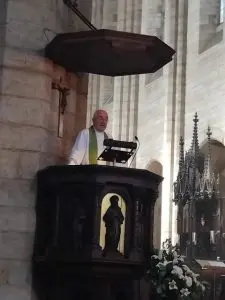
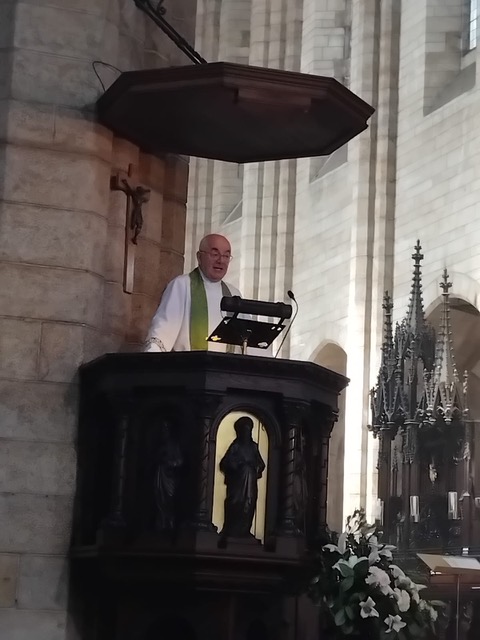
- Dean Dominic preaches from the pulpit at St George’s, Cape Town
-

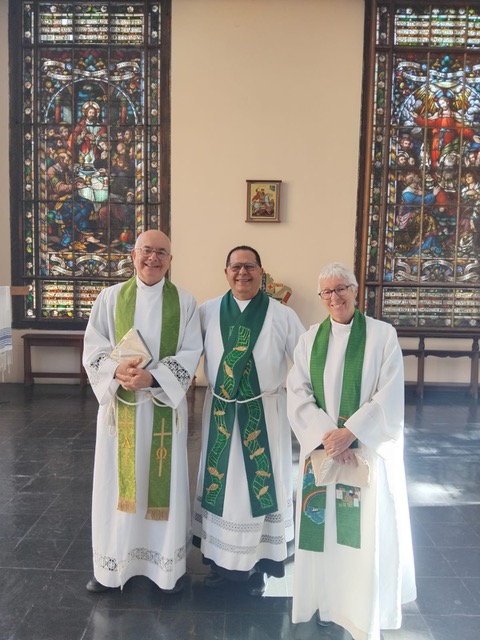
- Dean Dominic pictured with Dean Terry and Canon Maggie
-
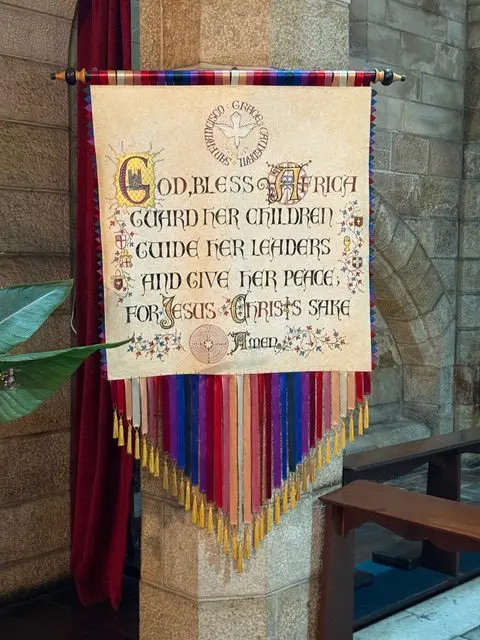
- A ‘God Bless Africa’ banner on display in St George’s Cathedral
But while it’s a joy and a blessing to share in this act of worship with you today, I’m still worried by the question – because I hear our readings shouting at me, “Are you crazy?”
Because today’s gospel is about utterly irrational behaviour. Today’s gospel is about doing things which make no sense at all. Doing things which are economically ridiculous, and which – to someone with a diary that is full to over-flowing with tasks that should have been done yesterday and meetings that must be attended tomorrow – things which are simply a waste of time. Today’s gospel is about being crazy.
This morning’s gospel is crazy, because the wilderness is a dangerous place. After all, it was in a wilderness that Jesus found himself spiritually wrestling no less a figure than the devil himself. And in a dangerous place like that you do not simply abandon 99% of your assets, whimsically to go off to find the one that has gone missing. I’m afraid the missing sheep – and, indeed, the missing coin – that’s just an asset you write off on the balance sheet of life. It is not something which – if you are sane, or rational, or efficient, or competent – if you are anything other than crazy – you just forget about.
After all, they tell us that time is money, and so many of us have far too little time to do the things that we even want to do. So not only would it be a crazy waste of time to go looking for that sheep, or that coin… it would be just as crazy to drop everything and run off when your neighbour summons you to an impromptu party they’ve decided to throw – something just to celebrate their craziness.
Let’s be honest. This is how real life works, isn’t it? This is the life that I find I have to I live if I’m going to survive the pressure of work, and family life, and all the rest of it. I don’t have time to be crazy, I don’t want to be crazy – at least, that’s what I find when I find myself looking in the mirror, let alone in my diary, or – when I dare to do so – in my conscience, or my heart.
Even today, some people look up to clergy, and I hope they find in me an example of someone who is rational, and ordered, and in control, somebody who is capable of running a very big cathedral with an awful lot of staff and worshippers and visitors and tourists… I hope they think I’m a good example.
And then that little voice pops the pin in the balloon of my smug, self-satisfied condition, and I hear that man saying to me again what he’s always said, when I quieten down enough to listen (which is not as often as it should be). And that voice says, “Are you crazy? Dominic – are you crazy?” Or, in the words of our gospel this morning, “Which of you does not go after the one that is lost…?”
And that is why I am so lucky – why we are so lucky – why we are so blessed to come to church this morning, and to discover we seem to be surrounded by some really crazy people.
Take St Paul. He’s a pretty frequent visitor to church most Sundays. Look how crazy he was. He knew all about the demands of what you and I probably call ‘real life’. Especially back in the day when he was more usually known as Saul – he knew all about that. He knew what tasks had to be done (mainly arresting these crazy followers of some jumped-up nobody of a rabbi from the north), and he knew just how to go about doing that. He was busy, he was capable, he argued really well. He had it all in hand. Until something crazy happened – something crazy which threw him off his horse, dazzled him with a light brighter than anything he’d ever known before, and gave him a new, crazy, outlook on life. And it was catching…
Paul’s new craziness was really catching. Because, if we are going to be honest, for many years Biblical scholars have been telling us that it is highly unlikely that the person who wrote One Timothy was actually Paul himself. Now, if you go to a university today and make false claims about authorship, and you’ll be out on your ear on a charge of plagiarism before you can snap your fingers.
But back in Biblical times, having your disciples attempt to echo your thoughts and what you stood for after your death – that was the highest praise. And so, someone – as I say probably not Paul, but one of those who had ‘come to believe’, because in Paul they found someone who was a really good example of how to live life – someone who had been touched by Paul’s craziness – someone else got it. And they used Paul’s name and identity to keep his ideas alive, and that someone else starts talking, in One Timothy, about how good it is – what a good example it is – to be crazy.
And so this morning, this shadowy author is speaking to us about how grateful he is that God strengthened him – strengthened him to be able, also, to live a crazy life, to be an example to others… To others who might find themselves needing to find a lost sheep or a lost coin when the rest of the world is saying, “No, no, no – be sensible. Don’t bother about that. It’s not the effort.”
And the story of Christianity, and the story of the Church of God – that story carries on like that, through the generations. And – on this particular morning – we get reminded that even in our own time, that craziness is a craziness which can change the world.
On this particular morning, we get reminded that there are too many people living for ideas that will die… but that if you are crazy, you learn – if that’s what it takes – to die for an idea that needs to live.
For this Friday was the 48th anniversary of the murder of Bantu Stephen Biko – a man touched with just the same kind of craziness that makes people search out what is lost sheep against all the odds. A man who was so certain that the evil ideas of the apartheid government were ideas that would die that, in the short life that he lived, he demonstrated with such clarity, that crazy idea of dying for the idea of a truly free South Africa that could, as he said, “be a community of brothers and sisters jointly involved in the quest for a composite answer to the varied problems of life.”
But, back in the bad days of the 1970s, certainly for those of us watching in anguish from around the world, that idea which, for Steve Biko, was worth dying for – that idea seemed little short of impossible. It seemed as elusive as the one lost sheep in the wilderness or the lost coin in the house. And I don’t know if I would ever have been crazy enough, or saintly enough, to put my energy into going to find it – I don’t know if I would have been crazy enough to drop everything to seek out such an unlikely excuse for a party.
It has been an honour, a joy and a privilege for Canon Maggie and myself to spend some time in this country. We have been looked after and cared for with a profound sense of welcome and with grace and kindness. We have tried to engage meaningfully with the history of the country and with some of the towering, visionary, crazy people who helped bring a transformation that for so long had seemed as improbable as finding one lost sheep.
And we’ve also had some fun while we have been here. We have learned much from your gracious Dean, Fr Terry, who is, let me tell you, a most excellent tour guide. And with him, we enjoyed a lovely visit to the farm and winery at Babylonstoren. For those who have the resources to enjoy its luxury goods, it clearly is a place that offers very high quality produce, and some very fine wines – wines which are marketed successfully around the country.
And thus, as we parked up, we saw the sign pointing people to the location to which they should go if they had ordered Babylonstoren wines in advance on a ‘click and collect’ basis. ‘There you are,’ said Fr Terry, ‘everything these days is click and collect’.
But in fact – if I may gently contradict you, Father – not quite everything is click and collect.
On 18th August, 1977, Steve Biko was arrested at a police road-block near what is now Makhanda – arrested, never to be seen again by his friends or family. Arrested, and subjected to repeated severe violence, denied medical care, and left alone, shackled, naked, in a police cell. For 25 days, until his death in Pretoria, he had, in effect, vanished, like a lost sheep. He was lost in the evil, inhuman, violent and murderous wilderness of Vorster’s apartheid regime.
But he was never lost to Jesus – to the utterly crazy Jesus of whom we read in this morning’s gospel – the utterly crazy Jesus who was determined that even when Steve Biko was apparently lost to human society, beaten and bleeding in a lonely prison cell – he was not lost to God. Not lost to the God – who in the person of Christ – calls us and reminds us, crazily, never to stop searching for what is lost and precious – whatever the cost.
Because, as we are reminded so strongly in our gospel today, Jesus was not a ‘click and collect’ God of convenience and comfort – Jesus was crazy enough to journey through the wilderness, through the wilderness of this life, himself bloody and beaten in Golgotha, and – abandoned by his friends – to death on the cross. Jesus was crazy enough to do all that to search out you and me, and every precious rainbow child of God.
And that craziness is infectious, my sisters and brothers. It infected Paul. It infected Paul’s disciple who, in all likeliness wrote that reading. It infected Steve Biko, it infected and beloved Archbishop Tutu, and so many crazy Christians down the centuries, who have been for us that good example.
And so, this morning, when Jesus says to us, once more, “Which one of you – which one of you is crazy enough to go and seek out that lost sheep, whom I happen to love very very much?” Let’s make sure we can be that good example for those who come after us, let’s hope that we can raise our hands, and say, “that’s me – I’m that crazy.” Amen.
Stay up to date with York Minster
- Event alerts
- Seasonal services
- Behind the scenes features
- Latest Minster-inspired gifts