

This morning, Canon Maggie fascinated our 11am congregation with a mini-biography of St Nicholas of Flüe – the patron saint of Switzerland who fathered ten children before deciding God was calling him to a life of quiet contemplation as a hermit. She made the utterly valid point that the patron saint of Switzerland was as obscure outside his territory, as York’s own patron William – resting in peace directly beneath us right now – is outside this noble city of York.
With a laugh, and with raised eyebrows, I think it fair to say that the worshippers this morning were not entirely convinced that bailing on your responsibilities as a husband and father of ten, to seek out a life of quiet prayer was really an appropriate response to the call of God in his life. But then, the life of this city’s equally obscure patron saint is also, it must be said, not an entirely convincing story of inner sanctity.
York’s own expert on William, Professor Christopher Norton, notes his subject’s obscurity in the opening words of a masterful study of the saint, published some twenty years ago – acknowledging that such fame as he has come to possess derives almost entirely from an extended dispute about the archbishopric, which, as he explains, ‘developed from being a little local difficulty into an international cause célèbre involving kings, cardinals, popes and several men who were subsequently to be reckoned as saints, all divided between… different factions’.
When you add to this background a fairly pervasive modern view of William as being ‘wealthy, indolent and immoral’ (to quote Professor Norton again), you might well be wondering what on earth all the fuss was ever about. You might well wonder how on earth it could be the case that such a figure could ever be declared to be a ‘saint’ at all.
It is certainly enough to make you scratch your head when you remember that William’s remains lie in the heart of a cathedral dedicated to no less a saint than Peter – the ‘prince of apostles’, and one of Jesus’ closest friends and followers.
It is certainly enough to make you scratch your head when, on this, William’s feast day, the spotlight of one of our two readings falls on that equally famous saint Paul, pictured this afternoon having that tearful farewell with the elders of the church he founded in Ephesus.
At least, it makes you scratch your head that William Fitzherbert, this controversial twice-Archbishop of York should be counted a saint when stood alongside the likes of Peter and Paul, until you start looking at these two pillars of God’s church a little more thoroughly.
After all, the patron saint of this great cathedral is the man whom Jesus once addressed as Satan, the man who was constantly blundering awkwardly into situations and getting them wrong, and the man whom Jesus accurately predicted would deny him not once but three times.
And Saul-turned-Paul doesn’t necessarily come off any better. It is clear from the pages of the New Testament that he was an incredibly divisive figure: he was, let us not forget, someone who took pleasure in watching an innocent man being stoned to death and ‘approved’ of it… he was someone who had had a blazing row with Peter about the nature of Christianity … he was someone whose letters verged on the intemperate, with angry remarks about wishing his opponents would castrate themselves.
And once you start scratching your head about the reality of the lives of those we call saints – be they characters from the very pages of the Bible, or obscure medieval churchmen, you begin to realise that God seems to choose some remarkably poor material to work with… from Peter and Paul with all their vivid and visible faults, through William, through Nicholas Flüe, and down to today.
At least – that’s what I realise when I look in the mirror. For when I look in the mirror, I recognize that, like the saint we commemorate today, I’m not universally popular. I recognize that I can make remarks that sound angry and intemperate. I recognize that there most certainly are times when I, too, have betrayed and denied the Christ whom I claim to follow. And it might just possibly be the case that I’m not the only person gathered this evening in York Minster of whom this is true.
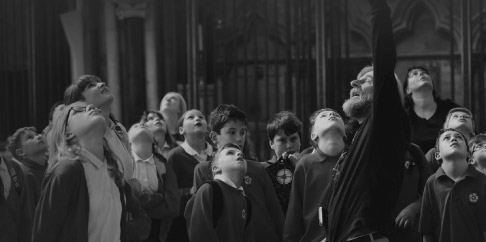
But – curiously – it is not all bad news, despite this rather compromised material which for some reason God seems to use in the mission and ministry of God’s church… It’s not all bad news, as some of our youngest church members were discovering this morning. For, while Canon Maggie was opening our eyes to the curious and obscure life of St Nicholas Flüe, around the corner in the Chapter House, something remarkable was happening…
For in our Sunday School, fifteen new archbishops were created this morning. William Fitzherbert found himself being remembered by fifteen small children, each holding hand-made mini-mitres, and each being affirmed in their own call to follow Christ and let their light shine out.
And recalling not a grand old duke, but a complex and sometimes combative archbishop, I am told they sang those well-known words that reminded them – and us – that when we are up, we are up… and when we are down, we are down… and like most of us, a lot of the time in our stumbling and sometimes mediocre lives, in truth, we will be neither up nor down. But God calls us, and God takes us and God finds us and enfolds us into God’s mission to God’s world, with whatever we manage to bring to the communal table of the church’s ministry.
For, as the famous Alabama lawyer Bryan Stevenson has stated so powerfully, ‘Each of us is more that the worst thing we’ve ever done’. And that profound truth reminds us that each of us can play a part in God’s mission. That was true for William of York, whom we remember today, and the Good News is that it is equally true for you and me – for God has a purpose and a use – God has a vocation for each one of us in the ministry and mission of the Church.
Because we deceive ourselves and we misread history and theology if we think that the mission and ministry which William Fitzherbert, Archbishop of York 1143-1147 and 1153-1154 exercised was his mission and ministry. Thank God… it was not. That would not have been Good News. That, I am certain, would not have worked well at all.
But the truth is, as Ezekiel, who found himself surrounded by way too many ‘false shepherds’ remind us – the truth is that ultimately, there is really only one shepherd. But even if at his worst William was, indeed, ‘wealthy, indolent and immoral’, at his best he was a beloved child of God who tried to align himself to the real Good Shepherd – and we know that there were times that he certainly succeeded, so great were the crowds who welcomed him back to York in December 1153, as he uniquely assumed the Archbishopric that second, short-lived time.
And that is our reminder that mission and ministry come from above, and we are all called merely to be the ‘support act’ to the unstoppable Good Shepherd who call us all to follow, and to lend a hand. And we need no mitres, no legacy in stained glass, and no professorial biographies to join in this mission and ministry – just a brief glimpse of that fact that, as the writer of the hymn we are about to sing put it so succinctly, ‘the way of self-giving, Lord, leads us to you’.
Amen.
Stay up to date with York Minster
- Event alerts
- Seasonal services
- Behind the scenes features
- Latest Minster-inspired gifts