
May I speak in the name of the Holy and Blessed Trinity One God in Three Persons.
Probably many of us in the Minster this afternoon know something about long-distance relationships. It may be that two people who fall in love live in different parts of the world, or the country, or perhaps it’s being at a distance for a specific period of time.
Many years ago, when, to put it in good Yorkshire terminology, I was ‘courting’, Chris was living in Lancashire and I was in Bedfordshire. We often spoke on the phone, and on one Saturday lunchtime we’d caught up for a brief conversation. As we were both curates, a busy day lay ahead of us. For some reason, later that afternoon, Chris just decided to get in the car and drive to Bedford. He didn’t tell me, but he knew I’d be saying Evening Prayer at 5 o’clock, so he drove down the M6 and M1 and was waiting by his car outside the church, just when I’d finished for the day.
Coming out of church, I saw in my peripheral vision someone standing by a car – but didn’t recognise that this was Chris. How could it be – he was in Lancashire! I didn’t realise it was him until the moment he spoke my name, and then the realisation dawned. In a moment worthy of the Song of Songs, Chris took my hands, gazed into my eyes and said: ‘this will serve you as a sermon illustration for decades!’
And so, it has.
Sometimes it’s very hard to see what we don’t expect.
Neuroscientists suggest that between 80% and 90% of what we “see” is actually constructed from memory and internal brain processing, rather than directly from our eyes. So, when our brain is telling us something can’t be, it’s actually very hard to see past that knowledge and recognise what’s really there.
For these reasons I’m not at all surprised that in the garden on that first Easter Day, Mary didn’t recognise Jesus. Seeing him alive was contrary to everything her brain, and her emotions, were telling her. On Good Friday she had seen him die, experiencing the most painful moment in her life. Now, in the garden, what she saw could simply not be true.
The two readings we’ve just heard bring together romantic love and resurrection love.
The Song of Songs is a passionate account of human desire and longing. “’I will seek him whom my soul loves.’ I sought him, but found him not”. The poetry of this book describes that unique experience, when we are drawn to place another person at the centre of our life. As we may know from our own experience, or from so many novels and poems, this can be utterly overwhelming. It leads the narrator of the Song of Songs to exclaim:
Many waters cannot quench love,
neither can floods drown it.
If one offered for love
all the wealth of one’s house,
it would be utterly scorned.
It is an extraordinary, extravagant love. The kind of love that makes us lose ourselves in the object of our desire. As the poet says, “I held him, and would not let him go”.
That reading informs our hearing of the second lesson. Here is Mary Magdalene, who, in realising it is Jesus, moves to envelop him in her arms. What was too good to be true turns out to be real – and Mary isn’t going to let him go again. But this love, this glorified embodiment of God’s total love for the world, can’t be pinned down in a single place. This love isn’t just for Mary; it is a love that promises to meet every person in their need. Whether behind locked doors, or prising open hearts closed tight with fear, the resurrection light pierces our deepest gloom. Perhaps at first, we don’t recognise it – or think it’s simply too good for us – but this glory refuses to be stopped.
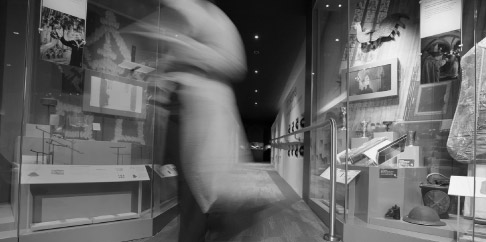
Last year I was celebrating Easter in Santiago de Compostela. There with countless pilgrims from across the world. Visiting the Museum of Pilgrimage I came across an artistic arrangement of many different pilgrim walking sticks. All unique, with a variety of shapes and sizes, colours and materials, each one was a silent reminder of all those very different people who make that journey to the tomb of St James. As in all pilgrimages, there are joyous days, and days when the whole thing feels like a painful folly. Yet every one of those sticks is a sign of the continuing work of resurrection – of lives changed, friendships made and the love of God embraced.
We don’t always see what’s in front of us, but I hope that this Easter, we all might be touched by the radiant light of the risen Christ.
Allowing that love which can never be quenched to be a seal upon our heart, and that we too may exclaim in startling wonder:
‘I have seen the Lord’.
Amen.
Stay up to date with York Minster
- Event alerts
- Seasonal services
- Behind the scenes features
- Latest Minster-inspired gifts