
“Holy Father, protect them in your name that you have given me, so that they may be one as we are one.”
May I speak in the name of the living God, who is our creator, sustainer and redeemer. Amen.
A few weeks ago, I was undertaking the daily ritual of making the day’s first cup of tea, a sacred ritual upon which the success of the rest of the day depends. I carefully filled the kettle, set it firmly on its base, pressed down the switch, and waited. And waited. And waited.
There is a particular kind of impatience reserved for kettles, especially when one is preparing that first cup of tea. It may be disproportionate, even irrational, and yet somehow it feels entirely justified. I pressed the switch again, checked the lid, lifted it off and put it back down, as though the kettle might respond to encouragement.
By this point, I had moved from mild inconvenience to quiet irritation. The kettle, it seemed, had simply stopped working. I would have to forego my early morning cup of tea, the rest of my day hanging on a thread. And then I noticed the plug. It was not in the socket.
Nothing was wrong with the kettle. It was not broken. It had not failed. It was simply not connected to the very thing that would allow it to do what it was made to do.
A small and trivial moment, but a gift as a sermon anecdote. For we far too often rush to diagnose failure. We assume that something is broken. We worry that life is not working as it should. But sometimes the deeper problem is not failure, it is disconnection. Rather than something being broken; we are simply not connected to the source that gives us life.
And that takes us to the heart of the Ascension.
The Ascension is not Jesus leaving the world behind. It is the moment when the risen Christ carries our wounded humanity into the very life of God. The crucified and risen one does not set aside the wounds of love. He ascends with our humanity, so that, through him, earth and heaven are joined.
And Jesus does not simply pray that we may be helped by God, instructed by God, or protected by God, though all those things matter. He prays that we may be drawn into a deeper connection, into the communion of God’s own life. He prays that the love shared between the Father and the Son may be the place where we connect. “…so that they may be one as we are one.”
This is not a transactional offering. This is an invitation to participate. This is not God assisting us from a safe distance. This is God drawing us into himself.
This matters, because so much of our life, and therefore so much of our imagination, is shaped by transaction. We are taught to believe that flourishing comes from achievement, from productivity, success, and self-sufficiency. I perform, in order to be valued. I succeed, in order to matter. I give, in order to receive.
And if we are not careful, we bring that same logic into faith. We imagine that if we pray hard enough, believe strongly enough, behave well enough, or worship faithfully enough, then God will reward us with the life we want. Prayer becomes a mechanism. Worship becomes a bargaining tool. God becomes the one who blesses our plans.
But that is not the Good News of Jesus Christ. God is not offering us a transaction. God is offering us communion. Human flourishing is not found by bargaining with God or impressing God. It is found by being connected to God, the source of life itself.
That is also the lesson the disciples have to learn. In Acts, they ask Jesus, “Lord, is this the time when you will restore the kingdom to Israel?” It is a very human question. They want to know what happens next. They want a timetable. They want the plan, the map, and the strategy.
We understand that longing. We want to know how and when things will change, how and when peace will come, how and when pain will ease, how and when the Church will be renewed.
But Jesus does not give them, or us, a timetable. He offers them a promise: “You will receive power when the Holy Spirit has come upon you; and you will be my witnesses.”
They ask for information. Jesus promises connection. They ask for certainty. Jesus promises the Spirit. They ask to know the plan. Jesus draws them into the life and work of God.
And then he is lifted from their sight.
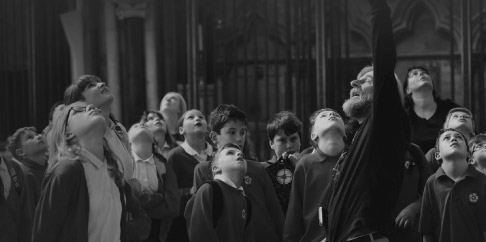
No wonder the disciples are left staring upwards. But the angelic question presses them onward: “Why do you stand looking up toward heaven?”
It is not a rebuke of worship. It is a summons to vocation. The disciples are not being told that heaven does not matter. They are being told that heaven has now claimed earth. They are not being told that Christ is absent. They are being prepared to discover his presence in a new way: through the Spirit, in the gathered community, in prayer, in witness, in the breaking of bread, and in the costly work of love.
And the life they seek will not be found by staring upwards as though God were elsewhere. It will be found by connecting to the life of God and then living from that connection in the world God loves.
That is why the Eucharist stands at the heart of our life together, for we do not come to the altar to negotiate with God. We do not come to purchase grace with our goodness. We do not come because we have understood everything or made ourselves worthy. We come with empty hands. We come to receive.
The Eucharist is the antithesis of religious transaction. It is communion. It is the life of the risen and ascended Christ given to his people. Here heaven and earth connect. Here Christ is not less present because he is ascended, but more deeply present: before us, among us, within us.
We are presently in that strange and holy liminal space between Ascension and Pentecost, where the Church finds itself between what has been revealed and what is still to be received; between knowing where the source of life comes from and learning how to live from that source.
And perhaps that is where many of us find ourselves too. We know enough to recognise that something is wrong. We know the barrenness of living transactionally, as though love, faith, service, and even prayer were things we use in order to get something back. We know that a life built only on productivity, control, and achievement cannot finally sustain the weight of the human soul.
But the Ascension reveals how we are to respond. It shows us that the life we seek is not generated by frantic effort, nor secured by looking upwards towards a distant heaven, but received through our connecting with the risen and ascended Lord.
Yet that does not leave us passive observers. The kettle may have needed power, but someone still had to notice the disconnection, put the plug into the socket, and press down the switch. Grace is gift, but it calls forth response. Communion is offered, but we must allow ourselves to be drawn in. The Spirit is promised, but the disciples still have to return, gather, wait, and pray.
So our question this morning is not simply, “What is broken?” Nor even, “Where is God?” The question is: are we connected? Are we connected to the source of life? Will we stop pressing harder on mechanisms that cannot save us, and instead open ourselves to the life Christ has promised?
For when we are connected to that promise, when we are plugged into the grace already given, when we have pressed the switch not in anxious striving but in faithful response, we discover that we are not merely repaired, improved, or made more effective. We are connected into the life of the risen and ascended Christ, held within the communion of God’s own love, and sent in the power of the Spirit to bear witness to this astonishing truth: heaven has claimed earth, grace has broken open the world, and all things are being made new.
Amen.
Stay up to date with York Minster
- Event alerts
- Seasonal services
- Behind the scenes features
- Latest Minster-inspired gifts