Simon Peter went aboard and hauled the net ashore, full of large fish, a hundred and fifty-three of them; and though there were so many, the net was not torn.
Eastertide is the season when we learn to talk about God. And – if we do that well… if we do that really well… then we might even learn to talk about the implications of God – the implications of a God who does resurrection.
But talking about God is not always straightforward – especially if we want to talk about a God who does resurrection – talking about God is not always straightforward, because it demands us to do a lot of thinking – or rather re-thinking. Talking about God – when it is done properly – demands of us a radical rethink about how we understand the world, and the possibilities it contains. And that is why people who talk about a God who does resurrection have not always been popular – especially with authoritarian or totalitarian rulers and political systems.
God has, of course, been doing resurrection for a long, long time. Resurrection is not some one-off event we find at the end of the four gospels in the New Testament. Resurrection has permeated all of tonight’s service, much of which is focussed on a fascinating part of Israelite history in the latter part of the Sixth Century before the Common Era. In the ever-turbulent history of the Middle East, that century was one of the most dramatic, for it contained the siege of Jerusalem that culminated in the destruction of the Temple, the sacking of the city, the massed deportations of its leadership into a bitter exile in Babylon in 587, and the ending of any sense of true Israelite sovereignty for just over two and a half millennia.
And while this was, amongst other things, a huge geopolitical disaster, an economic disaster, and a cultural disaster, it was more than all that – in that, for the Israelites, it saw the destruction of God’s own house (think Buckingham Palace or the White House). It saw the destruction of God’s very dwelling place on earth, and with it, the complete termination of the religious life and practice that was at the very heart of the people and the nation. God expected sacrifices to be made in the Temple – but now there was no Temple in which to make such sacrifices, and neither were there people qualified and appointed to do the sacrificing. It was – or rather it should have been – the end of the religious and political existence of this small group of semitic people, scattered into exile in a large and unfriendly new environment.
But it was not the end, for the Israelites learned to talk about God with greater understanding and greater clarity than they had ever known. They began to work out the implications of talking about a God who does resurrection. Not, yet, resurrection of a human being to a new and more glorious form of life… but the resurrection of a people who discovered that God was – of course – present with them in exile, and that God could be ‘accessed’ or ‘discovered’ in a myriad of ways other than through the sacrificial cultic practices of the Jerusalem Temple.
And because empires rise and fall, and political leaders come and go, in addition to having discovered the presence of God through holy time and holy ritual, not just in one holy place in the Temple (for it was in exile that the Jewish people fully discover the blessings of sabbath observance and special meals), because the world does not stand still, the people of Israel discover that God will ‘resurrect’ even Jerusalem itself, as we heard the prophet Zechariah proclaim in our first reading. And just in case that was not enough, God was going to make it a symbol of resurrection not just for one people – but for all people – even Israel’s sometime oppressor Babylon, as we heard declaimed in Psalm 87, which dates from this same remarkable period of history.
And it didn’t end there. For God never stops calling humanity to buck up its ideas and to start thinking about resurrection and the implications it brings – implications which consistently turn the world on its head, and which confound normal expectations and ways of behaving. After all – most of us, if going for a swim in a lake, would remove our clothes… but in the light of resurrection, we are told that Simon Peter puts his clothes back on before jumping into the water!
And it is just as well that he does, because he is about to have a life-changing breakfast which will lead to him being recommissioned to go and change the world – all because of the implications of talking about God – about a God who just can’t stop doing resurrection.
Which is why – of course – the unbroken net is full to bursting of so many fish. And did you notice just what an odd detail that was? After all, when we get numbers in the Bible – certainly when we get numbers bigger than 12 – we tend to get large, imprecise numbers. The ‘forty’ days of Lent, from the story of Jesus’ temptations in the wilderness, those ‘forty’ days really just mean a long time. The number is not specific – a number like that is meant to be vague.
But the miraculous catch of fish is utterly specific – 153 of them. A precise number, which comes at the very end of a gospel devoted to helping us use symbolism to understand the nature of a God who does resurrection.
Saint Jerome, writing in the Fourth Century, claimed that this number reflected precisely the number of species of fish known to the world in this era. A perfect and inclusive biological number. And mathematicians can expound endlessly on the fact that 153 is a triangular number – the triangular number of 17 – and that 17, itself, is a fascinating number, something called a Fermat Prime. And at this point be glad that I nearly failed my A level maths 46 years ago, and I can’t really explain exactly what all this means… but what I can tell you is that the author of the Fourth Gospel is talking about a precise number and an unbreakable net, because it happens to be his way of saying that God does resurrection, and that this has implications.
And that’s what all the New Testament authors do, each in their own particular manner:
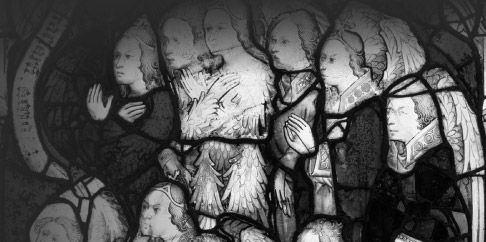
Luke talks about Jesus ascending into heaven and being exalted to the right hand of God; Matthew and Mark talk about the kingdom of God coming among people; Paul talks to us about living with the ends of the world upon us, and that a new and final creation of the world had begun; the writer to the Hebrews talks about us possessing the spirit of God and tasting the powers of the age to come; the author of Revelation, helped in the early 15th century by our wonderful glazier John Thornton, talks to us about victory in seismic battles that will lead to the creation or re-creation of a new heaven and a new earth…
And so on, and so on, and so on down the ages… in each and every generation, there have been those who have found themselves metaphorically jumping into the water fully clothed; there have been those who have found themselves spiritually having an unexpected breakfast on the beach that redeems them and all their past mistakes; there have been those who discover that nets remain unbroken and that their catch of fish is unnervingly, curiously, precisely inclusive and utterly perfect…
Writing about another curiously unnerving religious moment of resurrection – one that happened not just a very long time before Jesus was born in Nazareth, but even before the events of the Exile, the poet Elizabeth Barrett Browning wrote that:
Earth’s crammed with heaven, and every common bush afire with God. But only they that see take of their shoes – the rest sit round it and pluck blackberries.
You may have thought that you came to Choral Evensong today of your own volition, but it isn’t really like that. God called you and me to gather here tonight, just as God calls us to go out from here and to stop plucking blackberries, and to start counting fish, and to make sure we keep proclaiming God’s Good News to this unlistening world.
Amen.
Discover
York Minster
Stay up to date with York Minster
- Event alerts
- Seasonal services
- Behind the scenes features
- Latest Minster-inspired gifts