The Rose Window: An Extraordinary History
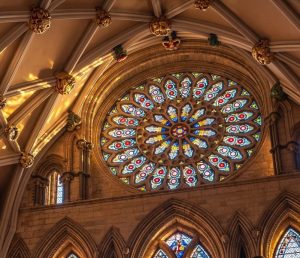
The Rose Window is one of York Minster’s most spectacular treasures. This 73 panelled stain glass is not only visually striking but it has a fascinating history as well.
Origins
The stone tracery of this magnificent window was completed around 1240, although none of its original 13th-century glazing survives. Instead, the window contains a fascinating collection of glass from different periods.
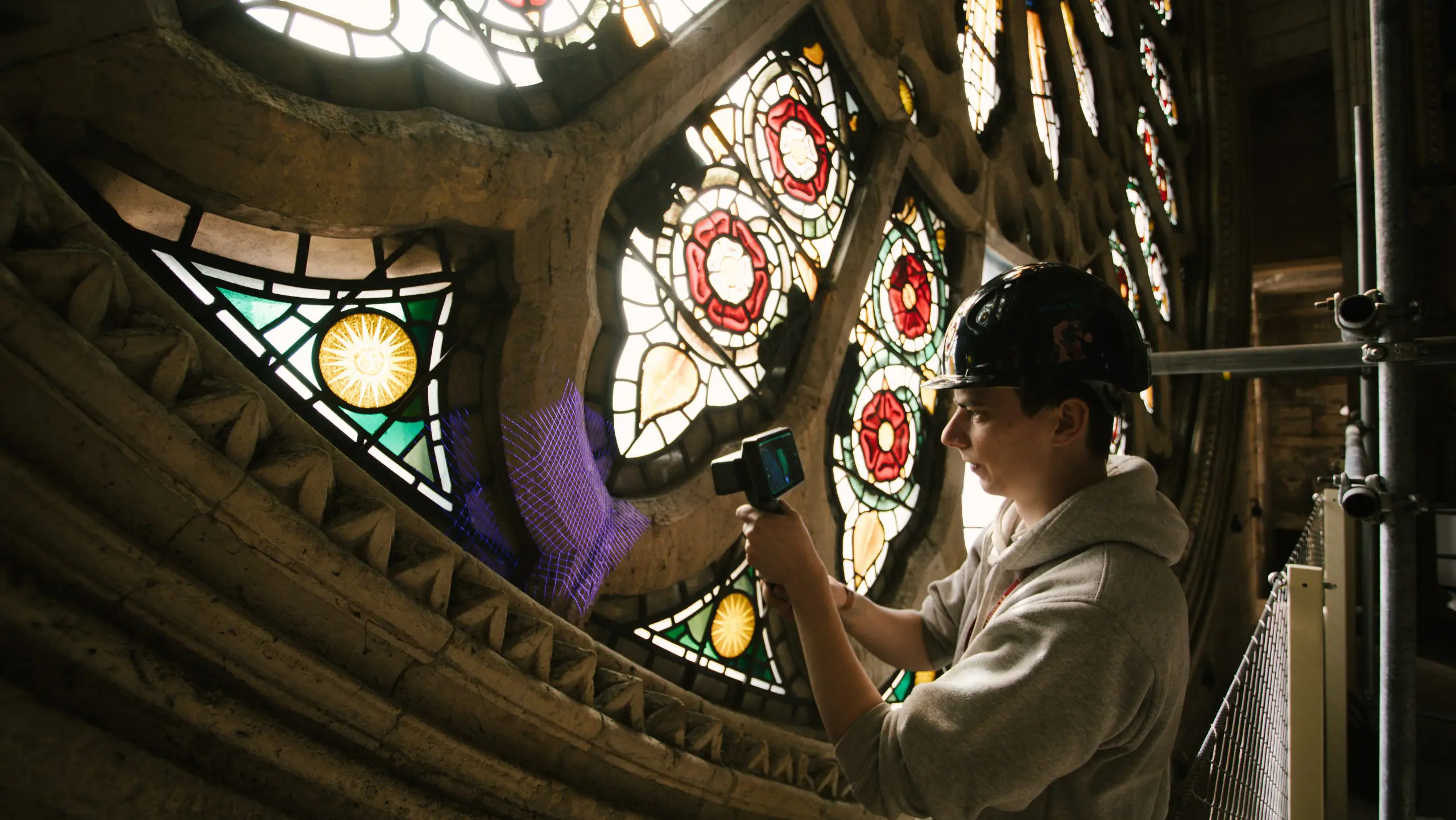
The glass that gives this window its name, the roses, dates from around 1500 and was probably created by John Pety, the distinguished glazier and Mayor of York. Its design incorporates the red rose of Lancaster alongside the red-and-white Tudor rose, and is widely believed to commemorate the end of the Wars of the Roses. The window celebrates the union of the houses of Lancaster and York, sealed by the marriage of Henry VII and Elizabeth of York in 1486, which marked the beginning of the Tudor dynasty.
Later Restorations
The sunflower in the centre of the window dates from the restoration carried out by William Peckitt in 1793, one of the most celebrated glass painter’s of the eighteenth century. The window was restored and releaded again in 1970, when 24 triangular panels were added to complete the design.
The Fire of 1984 and the Saving of the Rose Window
In the early hours of 9 July 1984, York Minster was struck by lightning and suffered one of the most devastating cathedral fires of modern times. The cathedral’s Rose Window, an enduring symbol of the union between the Yorkist and Lancastrian houses that had overlooked the city for more than 500 years, was exposed to temperatures of around 450°C resulting in 7,000 pieces of glass being cracked in 40,000 places.
An extraordinary restoration effort followed to save the Rose Window. The Rose Window was saved through the astonishing work and technical skills of the York Glaziers Trust. This conservation work involved the delicate cleaning of each panel and the injection of epoxy resin adhesive into the micro-cracks in the glass. To strengthen the repaired glass, each piece was carefully sandwiched between modern clear glass plates.
Professor Sarah Brown, the former Director of the York Glaziers Trust, explained: “These windows have a history stretching back many hundreds of years. They can be attributed to the workshop of Robert Petty in the late 15th century and have undergone a variety of restorations and additions, as well as being completely removed during the Second World War.
“It was Peter Gibson OBE, former superintendent of the York Glaziers Trust, who insisted that the Rose Window could be saved after the 1984 fire. At the time, some people saw its perilous condition as an opportunity for a completely new stained glass commission! Thankfully, his advice was heeded and the glaziers worked tirelessly to restore the artwork.”
Protecting the Rose Window for the Future
A close inspection of the Rose Window in 2025 found that some of the repairs made following the 1984 fire are now beginning to deteriorate. Once again, this remarkable window faces serious challenges. Increasingly frequent extreme weather events, including heatwaves and intense rainfall, pose a growing threat to its long-term preservation.
Today, a new chapter in the Rose Window’s history is beginning. Through careful conservation and specialist technologies, we are working to safeguard this treasure for future generations.
Find out how you can support our Rose Window campaign.
The Life of St William of York
You’re not alone if you’ve never heard of St William of York. Though little known today, he was an important figure in medieval England both during his lifetime and after his death.
Our Research Coordinator, Dr Jennie England, explores the turbulent and troubled life of a man who was so dedicated to our city, from his early life through to his controversial election as Archbishop in 1141, subsequent fall from grace, triumphant return and ultimate untimely death.
The Rise of William fitzHerbert
Very little is known about William fitzHerbert’s early life. Cousin to the King, William quickly rose through the ranks at court, eventually securing himself the position of Treasurer of York Minster and Archdeacon of the East Riding. His successful 30 years in this position would lead him to secure the position of Archbishop of York by 1141 though there were some challenges he faced along the way…
Fall from Power
William’s election as Archbishop of York was plagued by intense political tensions and religious controversy. England was in chaos; a civil war between King Stephen and Empress Matilda had torn the kingdom apart. Whilst religious reform was to instigate new challenges that William would struggle to combat…
Return, Death and Legacy
As tensions cooled in England as civil war was brought to a resolution, and after William had spent many years in exile from the city of York; he returned in 1154 once again as the Archbishop. But this was not to be for long…..
The life, death and legacy of St William of York is one full of contention, political intrigue, murder and mystery. He now lies at rest in the Crypt of York Minster, a site of pilgrimage still to this day.
You can explore further the story of St William of York through the objects that bring it to life in our current exhibition, St William of York: Life and Legacy, open now until January 2027 and entry is included with your sightseeing ticket.
The Miracles of St William of York
Following the death of William fitzHerbert Archbishop of York, in 1154 he was laid to rest inside York Minster cathedral. Within a few months, miracles were reported at his tomb by those who had come to honour him and pay their respects. In recognition of the miracles reported, William was canonised by Pope Honorius III in 1226.
Across 95 panels of intricately detailed depictions, the St William Window in York Minster tells the story of William and the miracles attributed to him, in what was one of the largest narratives in stained glass ever made in Medieval England.
The First Miracle
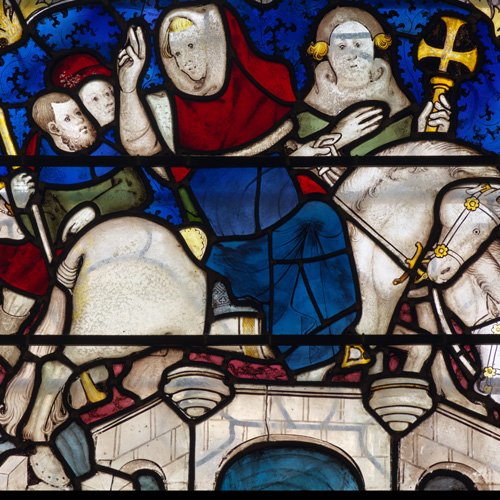
William was beloved by the people of York, and his reinstatement to the See of Archbishop in 1154 and return to the city was met with jubilant crowds. So many people came out to cheer and celebrate his return that as he crossed the river the weight of the crowds caused the timbers of Ouse Bridge to give way and collapse.
Large numbers of people were thrown into the river and were at risk of drowning. William, seeing the carnage, prayed to God for those in peril to be saved and he made the sign of the cross over them. All were saved.
This is considered William’s first miracle.
Miracles at the Tomb
Many miracles were reported at the tomb of St William of York where people from all walks of life, rich and poor, young and old, male and female travelled in pilgrimage to honour William and to seek help.
One miracle depicted in the St William Window tells of a woman who inadvertently swallowed a frog and then journeyed to St William’s tomb with her husband where she was cured by throwing it up.
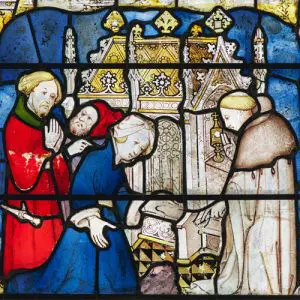
In 1223 a sweet-smelling oil flowed from William’s tomb. The flowing of holy oil was widely regarded as indicating sanctity and, though considered a commonplace saintly phenomenon William is the first English saint recorded to have performed this miracle.
There are numerous accounts of witnessed miracles at the tomb of St William from people who travelled from across the globe seeking help and healing. We can still relate to their concerns today: physical and mental illness, poverty, social injustice, concern for their loved ones, loss and grief.
Miracles to Protect from Danger
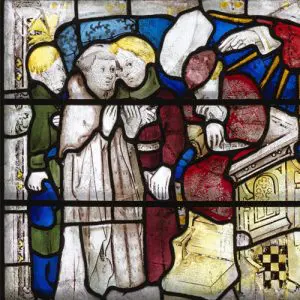
There are numerous reports of St William’s intervention to protect people from danger, from the King to a servant, all attribute their lives being protected to William of York.
Edward I, having accepted an invitation to attend the translation of the relics of Saint William, later has a near-fatal fall from a mountain whilst in Wales. The King was unharmed and he later ascribed his deliverance to have been from St William of York as he had promised to honour him.
A servant to one of the canons at York Minster fell asleep during Matins, whilst resting against the pulpit. A stone column of considerable weight fell on his head. Miraculously the servant is unharmed and he thanked the grace of St William and walked away.
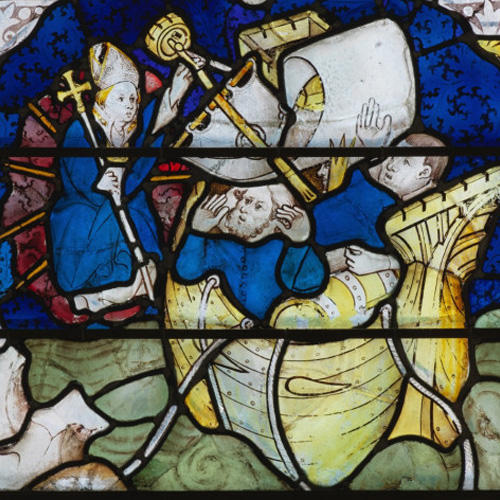
Sailors who were in danger of being shipwrecked, reported that St William appeared in a vision and their ship, which had suffered a broken mast in a storm was protected from running aground on the rocky shore.
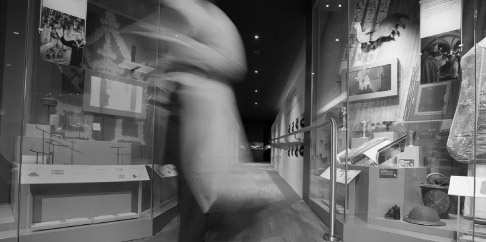
As we celebrate 800 years since the canonisation of William as a saint, take the rare opportunity to see pieces from his medieval Nave shrine returned to York Minster for the first time in almost 500 years. Explore his story and see precious artefacts which narrate the life of a man who devoted himself to our city and cathedral.
Plan a visit to our new exhibition.
All the images included above are panels from the St William Window at York Minster. Panel images above:
- ‘9c The miracle of Ouse Bridge’
- ’17c The woman is cured at the tomb’
- ’20d A servant is hit on the head by a stone’
- ’16e Saint William saves a ship with a broken mast’.
To explore further head to the York Glazier’s Trust Stained Glass Navigator to look closely at each panel and find out more of the miracles attributed to St William.
1984: Fire and Aftermath
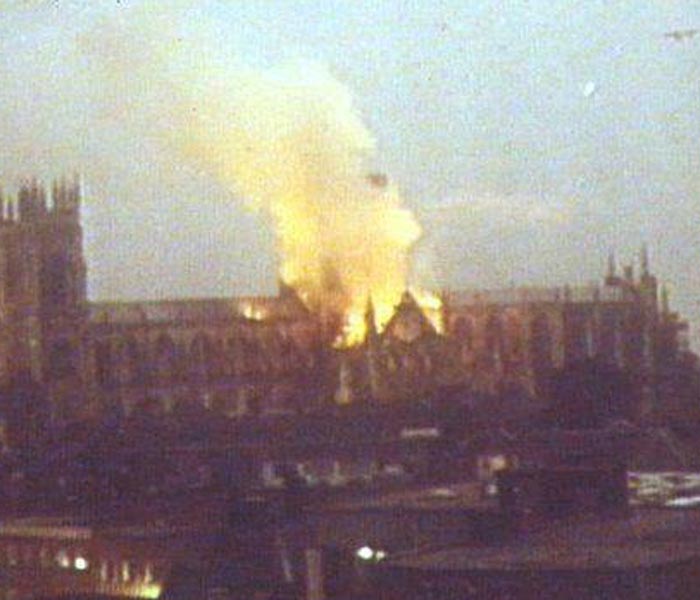
In the early hours of Monday 9 July 1984, York Minster was struck by lightning and suffered one of the worst cathedral fires of modern times. The damage done in just a few hours took over four years to be rebuilt and restored.
Join us as we remember the destruction, give thanks for the restoration, and continue our conservation of York’s magnificent but fragile Minster through poignant acts of worship, brand-new sightseeing activities, and a bespoke light and sound projection.
Explore Reclaimed from the Flames, York’s commemoration of the 40th anniversary of the 1984 fire.
What happened?
At 2.30am on the morning of Monday 9 July, fire alarms ring out at the Minster, automatically alerting North Yorkshire Fire Services who dispatched a team to tackle the blaze. The officer in charge could see at once that the fire was well established in the roof and had penetrated downwards through the vaulting.
Molten lead and debris were falling within the South Transept, making conditions hazardous at ground level. Firemen hauling hose lines up narrow spiral staircases to reach the roof were met with overwhelming heat. A 100 foot ladder was used to reach the blaze from outside the Minster.
 A water canon was set up inside the transept to direct a huge jet of water up towards the heart of the blaze from below. The famous Rose Window was being cooled by water sprayed on the stonework above. Water lines were laid from the River Ouse to support the efforts.
A team of clergy and residents led by the Dean of York worked to save irreplaceable artefacts from the smoke-filled building, dodging falling debris and covering their mouths with wet handkerchiefs to try and avoid smoke inhalation. Soon the Chapter House Yard was piled high with crosses and candlesticks from six large altars, as well as tapestries, books and frontals.
At 3.45 am, with fears that the fire could spread to the Central Tower or Nave, the decision was made to bring the South Transept’s irretrievable wooden roof beams down. Firefighters focused jets of water at the supporting beams to weaken the structure and, like a row of dominoes, the timbers collapsed. The weight of the falling structure dragged the remainder of the roof clear of the Tower and sent it crashing to the ground.
Once the roof material was on the floor, firefighters could work to extinguish the flames and start the long task of checking whether the fire had spread to other parts of the Minster. They battled through dense smoke to inspect the Nave, Quire and Central Tower.
Fire crews were in attendance for approximately 24 hours after the start of the blaze and pumped gallons of water out from the Undercroft beneath the Central Tower.
The Aftermath
As dawn broke the next morning, work began to assess the extent of the damage. The cathedral’s floor was covered beneath five feet of debris and the roofless South Transept left the cathedral’s interior exposed to the elements.
Miraculously, despite being exposed to 450C heat, the famous Rose Window had survived although it had cracked in 40,000 places. The York Glaziers Trust’s astonishing work, including applying
adhesive to each of the 40,000 cracks, saw it successfully restored four years later.
A close inspection of the Rose Window in 2025 found that some of the repairs made following the 1984 fire are now beginning to deteriorate. Once again, this remarkable window faces serious challenges. Increasingly frequent extreme weather events, including heatwaves and intense rainfall, pose a growing threat to its long-term preservation.
Find out how you can support our Rose Window campaign.
Permission of copyright owners has been sought and acknowledged where known. Copyright owners wishing to discuss the use of their images are asked to email collections@yorkminster.org.
Stay up to date with York Minster
- Event alerts
- Seasonal services
- Behind the scenes features
- Latest Minster-inspired gifts