
Our Week With History Hit
How do you tell the story of a window that has stood for more than 500 years and survived siege, fire, and civil unrest?
You bring in the experts.
That’s exactly why we teamed up with History Hit, the award-winning podcast network and online history channel dedicated to bringing the past to life for modern audiences through multimedia storytelling.
With a shared passion for making history accessible and engaging, they were the perfect partner to help us share the remarkable story of York Minster’s Rose Window.
Welcoming the Team
The Rose Window is a symbol of unity in the aftermath of the Wars of the Roses, the series of civil wars fought between the rival House of Lancaster and York throughout the 15th century.
The red and red-and-white roses of its design are thought to celebrate the marriage of Henry VII and Elizabeth of York, which united the rival factions and ushered in the Tudor dynasty. The  Lancastrian red rose is featured to reflect the House of Lancaster’s victory over the House of York, while the red-and-white rose symbolises of the two houses coming together.
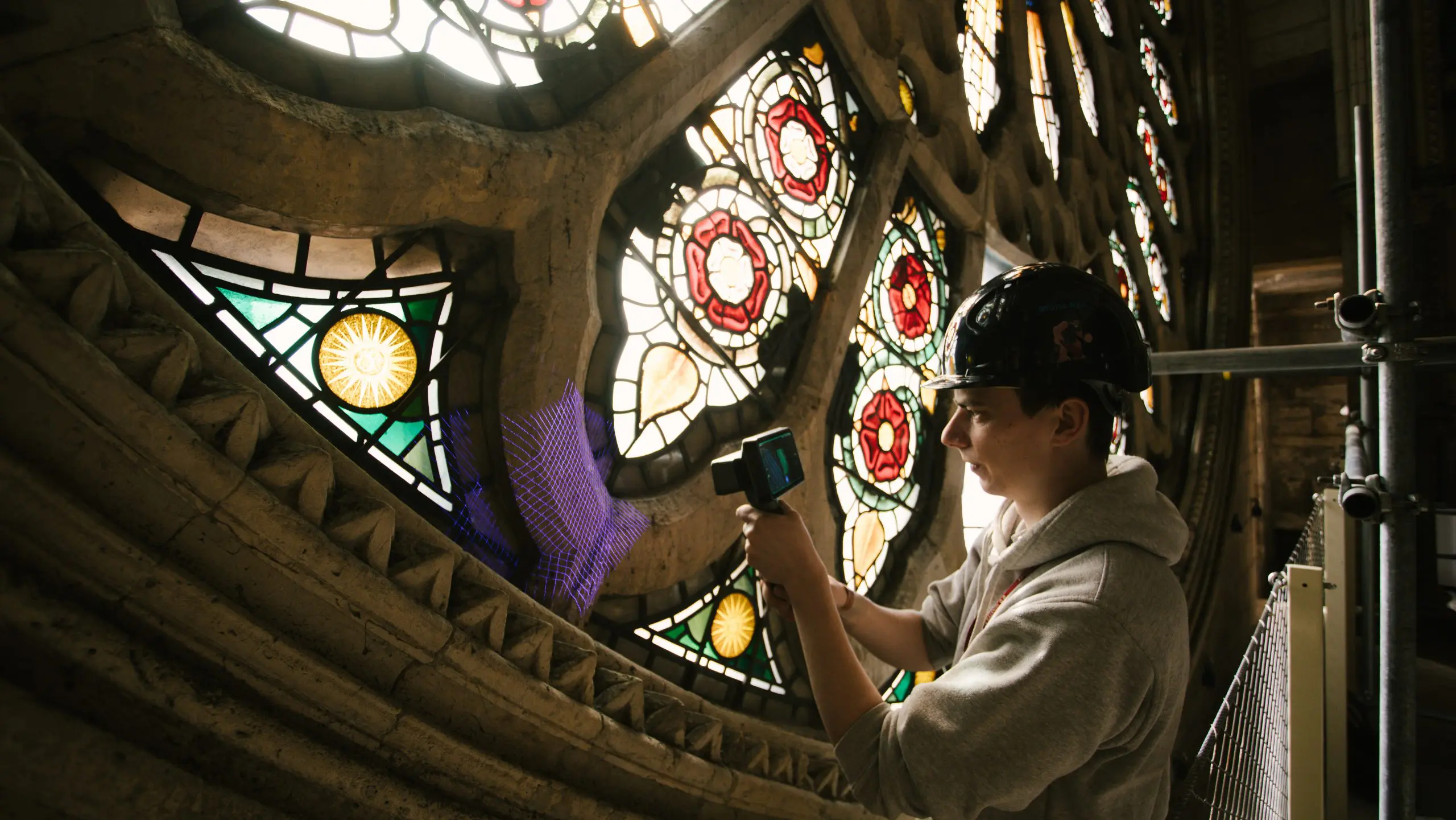
With such strong Tudor connections, it was only fitting to welcome historian Matt Lewis to the Minster. Matt’s expertise helped bring to life the history, symbolism, and significance of one of York Minster’s most iconic treasures.
One theory Matt proposed was that the inclusion of the yellow sun was a reference to Edward IV’s favourite badge, the Sun in Splendour. Edward was a Yorkist king and the father of Elizabeth of York. While an overt reference to the defeated Yorkist cause could not have been included in this window, Matt wondered whether this symbol might represent a subtle nod to Elizabeth’s father and her Yorkist heritage.
Up the Scaffolding
It’s a relief that this team had a head for heights!
We were thrilled to take Matt and the crew from History Hit up the scaffolding to see behind the scenes of the ongoing conservation project on the Rose Window. Matt met with Alex McCallion, Director of Works and Precinct at York Minster, for a closer look at the window.
From this unique perspective, Alex was able to share with Matt the latest chapter in the Rose Window’s history: its ongoing fight against the effects of climate change. Recent analysis has shown that the window is under immense pressure from increasingly extreme weather events, including intense heat, temperature fluctuations and heavy rainfall. Both the glass and the stone tracery surrounding it face a significant 21st-century threat. Alex was able to share how the Minster’s team at the Centre for Excellence for Heritage Craft Skills and Estate Management were working in partnership with the York Glaziers Trust to combat this threat. 
To the Glaziers Studio
Next, Matt and the History Hit team were invited into the studio of the York Glaziers Trust, Britain’s oldest and largest stained glass conservation studio.
There, they received a warm welcome from Dr Marie Groll, Director of York Glaziers Trust, and Sophie Gwynn, Team Leader and Conservator who showed them how they are protecting the Rose Window.
Sophie shared insights into the current condition of the glass, shedding light onto why this project is so important to undertake now. She also showed Matt how the team is using traditional techniques alongside modern technology to preserve every section of this window.
Be sure to look out for History Hit’s upcoming documentary featuring the Rose Window at York Minster, for an even deeper dive into its history, symbolism and the ongoing conservation.
In the meantime, find out how we’re preserving the iconic Rose Window for future generations and how you can donate to this important conservation project.
The Rose Window: An Extraordinary History
The Rose Window is one of York Minster’s most spectacular treasures. This 73 panelled stain glass is not only visually striking but it has a fascinating history as well.
Origins
The stone tracery of this magnificent window was completed around 1240, although none of its original 13th-century glazing survives. Instead, the window contains a fascinating collection of glass from different periods.
The glass that gives this window its name, the roses, dates from around 1500 and was probably created by John Pety, the distinguished glazier and Mayor of York. Its design incorporates the red rose of Lancaster alongside the red-and-white Tudor rose, and is widely believed to commemorate the end of the Wars of the Roses. The window celebrates the union of the houses of Lancaster and York, sealed by the marriage of Henry VII and Elizabeth of York in 1486, which marked the beginning of the Tudor dynasty.
Later Restorations
The sunflower in the centre of the window dates from the restoration carried out by William Peckitt in 1793, one of the most celebrated glass painter’s of the eighteenth century. The window was restored and releaded again in 1970, when 24 triangular panels were added to complete the design.
The Fire of 1984 and the Saving of the Rose Window
In the early hours of 9 July 1984, York Minster was struck by lightning and suffered one of the most devastating cathedral fires of modern times. The cathedral’s Rose Window, an enduring symbol of the union between the Yorkist and Lancastrian houses that had overlooked the city for more than 500 years, was exposed to temperatures of around 450°C resulting in 7,000 pieces of glass being cracked in 40,000 places.
An extraordinary restoration effort followed to save the Rose Window. The Rose Window was saved through the astonishing work and technical skills of the York Glaziers Trust. This conservation work involved the delicate cleaning of each panel and the injection of epoxy resin adhesive into the micro-cracks in the glass. To strengthen the repaired glass, each piece was carefully sandwiched between modern clear glass plates.
Professor Sarah Brown, the former Director of the York Glaziers Trust, explained: “These windows have a history stretching back many hundreds of years. They can be attributed to the workshop of Robert Petty in the late 15th century and have undergone a variety of restorations and additions, as well as being completely removed during the Second World War.
“It was Peter Gibson OBE, former superintendent of the York Glaziers Trust, who insisted that the Rose Window could be saved after the 1984 fire. At the time, some people saw its perilous condition as an opportunity for a completely new stained glass commission! Thankfully, his advice was heeded and the glaziers worked tirelessly to restore the artwork.”
Protecting the Rose Window for the Future
A close inspection of the Rose Window in 2025 found that some of the repairs made following the 1984 fire are now beginning to deteriorate. Once again, this remarkable window faces serious challenges. Increasingly frequent extreme weather events, including heatwaves and intense rainfall, pose a growing threat to its long-term preservation.
Today, a new chapter in the Rose Window’s history is beginning. Through careful conservation and specialist technologies, we are working to safeguard this treasure for future generations.
Find out how you can support our Rose Window campaign.
Preserving the Past; Illuminating the Future
Saving the South Transept and Rose Window
(2024 – ongoing)
Thanks to The Julia Rausing Trust’s initial grant of £500,000 in 2024 we were able to undertake early work on the three South Transept windows, as well as complete a detailed examination of the Rose Window for the first time in nearly 40 years.
When an investigation of the South Transept Windows in 2025 revealed a 92% degradation, compared to the anticipated 30%, the need for intervention became time critical.
In response, the Trust made an extraordinary additional £1 million grant in December 2025.
This funded the full increased restoration and protection of the South Transept windows of £460,000 and contributed £540,000 to launch the £1.4 million Rose Window campaign. This work included the complete re-leading of the South Transept Windows, which hasn’t been done since the £11.5 million Great East Window project which completed in 2018.
We are enormously grateful to the Julia Rausing Trust for funding this time-critical work, and for their lead gift to our Rose Window Campaign.
1984: Fire and Aftermath
In the early hours of Monday 9 July 1984, York Minster was struck by lightning and suffered one of the worst cathedral fires of modern times. The damage done in just a few hours took over four years to be rebuilt and restored.
Join us as we remember the destruction, give thanks for the restoration, and continue our conservation of York’s magnificent but fragile Minster through poignant acts of worship, brand-new sightseeing activities, and a bespoke light and sound projection.
Explore Reclaimed from the Flames, York’s commemoration of the 40th anniversary of the 1984 fire.
What happened?
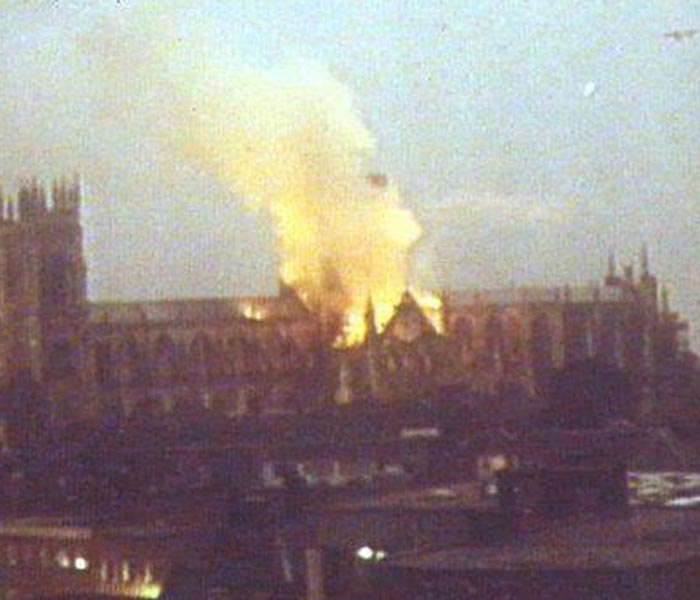
At 2.30am on the morning of Monday 9 July, fire alarms ring out at the Minster, automatically alerting North Yorkshire Fire Services who dispatched a team to tackle the blaze. The officer in charge could see at once that the fire was well established in the roof and had penetrated downwards through the vaulting.
Molten lead and debris were falling within the South Transept, making conditions hazardous at ground level. Firemen hauling hose lines up narrow spiral staircases to reach the roof were met with overwhelming heat. A 100 foot ladder was used to reach the blaze from outside the Minster.
 A water canon was set up inside the transept to direct a huge jet of water up towards the heart of the blaze from below. The famous Rose Window was being cooled by water sprayed on the stonework above. Water lines were laid from the River Ouse to support the efforts.
A team of clergy and residents led by the Dean of York worked to save irreplaceable artefacts from the smoke-filled building, dodging falling debris and covering their mouths with wet handkerchiefs to try and avoid smoke inhalation. Soon the Chapter House Yard was piled high with crosses and candlesticks from six large altars, as well as tapestries, books and frontals.
At 3.45 am, with fears that the fire could spread to the Central Tower or Nave, the decision was made to bring the South Transept’s irretrievable wooden roof beams down. Firefighters focused jets of water at the supporting beams to weaken the structure and, like a row of dominoes, the timbers collapsed. The weight of the falling structure dragged the remainder of the roof clear of the Tower and sent it crashing to the ground.
Once the roof material was on the floor, firefighters could work to extinguish the flames and start the long task of checking whether the fire had spread to other parts of the Minster. They battled through dense smoke to inspect the Nave, Quire and Central Tower.
Fire crews were in attendance for approximately 24 hours after the start of the blaze and pumped gallons of water out from the Undercroft beneath the Central Tower.
The Aftermath
As dawn broke the next morning, work began to assess the extent of the damage. The cathedral’s floor was covered beneath five feet of debris and the roofless South Transept left the cathedral’s interior exposed to the elements.
Miraculously, despite being exposed to 450C heat, the famous Rose Window had survived although it had cracked in 40,000 places. The York Glaziers Trust’s astonishing work, including applying
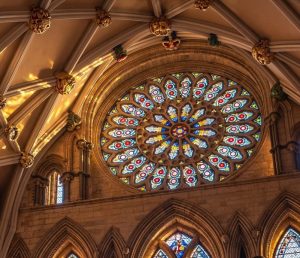
adhesive to each of the 40,000 cracks, saw it successfully restored four years later.
A close inspection of the Rose Window in 2025 found that some of the repairs made following the 1984 fire are now beginning to deteriorate. Once again, this remarkable window faces serious challenges. Increasingly frequent extreme weather events, including heatwaves and intense rainfall, pose a growing threat to its long-term preservation.
Find out how you can support our Rose Window campaign.
Permission of copyright owners has been sought and acknowledged where known. Copyright owners wishing to discuss the use of their images are asked to email collections@yorkminster.org.
Stay up to date with York Minster
- Event alerts
- Seasonal services
- Behind the scenes features
- Latest Minster-inspired gifts