



If you stand in the middle of the Old Town Square in the venerable city of Prague – something which I did with my family for the first time just a few days ago on a delightful half-term break – you are struck by the extraordinary mix (if not mess) of competing architectural styles, covering a period of nearly five hundred years.
With striking, first-rate examples of Gothic, Renaissance, Baroque and Rococo buildings, it feels as if a greedy child had demanded ‘one of everything, please’ in some sweetshop of architectural history. But the Square is a testament not just to variety of building, but variety of belief. For in the middle are two highly significant statues.
The first, originally erected in the mid 17th Century by the conquering Catholic Habsburgs, who had vanquished the Swedish Protestant forces, is a statue of the Blessed Virgin Mary atop a 16-metre tower. And within, shall we say, spitting distance, is a vast monument dating from 1915, of one of the most important figures of Czech history, the dissident priest Jan Hus, executed in 1415 as a heretic for what many would regard as being one of the first instances of what became known as Reformation teachings.
These two statues, let alone the churches which surround them on the Square, speak of different eras, different political authorities, and – more relevant to the great feast we celebrate today – different understandings of the Christian faith, of the mission of the Church of God, and even, perhaps, of what it might mean to be a saint.
Now, Hus is a complex figure, and I am skating on thin theological ice in my use of him in this sermon. He died over a century before Martin Luther nailed his 95 theses to the door of a Wittenberg church, which is the moment popularly acclaimed to mark the beginning of the Reformation. And there is no doubt that he was a devout, sacramentally committed Catholic priest, who – I am fairly certain – would have been bewildered, if not appalled, at the idea of creating a new or schismatic church.
What I think Hus wanted was for the Church to be more impactful in and for the world it was called to serve – for a better nurtured and informed laity, and for a better, more dedicated clergy, to be more Christ-like in their mission to a broken world. What he wanted, I think, was for the people called to be the ‘saints of God’ to ‘make a difference’ – to make a difference in a world facing a crisis of difference, tension and violence.
Which, perhaps, is a helpful key to unlock the passage we have just heard from the Letter to the Hebrews that tells us how God had provided something better so that they would not, without us, be made perfect.
In the extract from the penultimate chapter of the prophecy attributed to Isaiah that was our first reading, we are offered an intriguing vision of unity. Intriguing in so much as it is other-worldly (as the writer makes clear). For in the ‘new heavens and…new earth’ of which the prophet speaks, this unity will see the wolf and the lamb feed together, and the lion eat the same straw that feeds the ox.
But beautiful though such a vision might be, it is not a vision for us and for our age, because it is the lot of sheep, with their herbivorous lifestyle, to be the food on which the carnivorous wolf preys. The creation in which you and I live does not include them ‘dining across the divide’ in the amusing style of the Guardian’s Saturday magazine.
Unlike the prophet, however, the author to the Hebrews is not so much interested in the world that is to come, as in the world in which the saints of God are called to live right now. And there is a powerful unity in the vision that is set in front of us – a vision that is (or, rather, that should be) the inspiration for all those who look ‘to Jesus the pioneer and perfecter of our faith’.
We hear that unity specifically expressed in his use of the faith of various figures from the Hebrew Scriptures – those extraordinary characters whose achievements ranged from shutting lions’ mouths to winning great battles, while enduring persecution, torments, and a range of grizzly deaths. But all these figures, of course, despite the glory of their achievements, were not Christians, which, in the mindset of the author, means that they would not, without us, be made perfect.
Because ‘perfection’ is a team effort. It is a team which most definitely has a captain – which is why Hebrews speaks of Jesus being both ‘pioneer’ and ‘perfecter’. And it is a ‘perfection’ which can only be understood by the experience of the cross, from which, at the moment of his death, Jesus cries, “It is perfected” – the very same Greek word that, far too weakly, we more often translate as ‘finished’.
But the hard truth is for all that Jesus ‘endured the cross’, in the mindset of Hebrews, that great sacrifice offers the world very little if those who claim to follow Jesus fail to run that race ‘that is set before us’, and attempt to bring Jesus’ teachings to bear upon the life of the world. Or to use the language of this great feast day, if the saints of God do not live out their vocation, then the ‘great sacrifice’ might well have been in vain.
And that is why, in Hebrews, we are reminded on this day of all days, that ‘we are surrounded by so great a cloud of witnesses’ – because the mission of the Church of God is teamwork, and it will only be ‘made perfect’, or brought to completion, when we start behaving like a team.
This morning’s Sunday programme on Radio 4 heard something of a debate between the disgruntled former Professor of Applied Theology, Robin Gill, and Philip North, the Bishop of Blackburn. The point of contention was a report of which Professor Gill was one of the authors, which criticizes the growth of non-parochial administrative posts across the Church of England, and laments the decline in numbers of parish clergy.
Bishop North was not impressed with the report’s conclusions. In his eyes, it failed to understand the core difference between the Church of God and ‘any other institution’, and was shot through with an utterly inappropriate sense of inevitability about decline – something which he rebutted with some force:
“Now what I see…round the country is when clergy are really focussed on proclaiming the gospel and serving their communities there is growth. We are never going to re-organise ourselves out of a crisis – we need to evangelize ourselves out of a crisis.”
And, in truth, the crisis of the Church of England is not the real crisis. From where I am looking, the real crisis is that of a world ever more deeply divided in just about every way you might choose to examine – such as there being more armed conflicts across the globe than at any point since the Second World War; such as there being 1 in 13 people across the planet (some 645 million) being chronically undernourished; such as democracy being more vulnerable by any recognised measurement at any point since the ending of the Cold War; such as the increased sense of fear and vulnerability among both Jews and Muslims (let alone many other minorities) in almost every western country than at any point in most of our lifetimes….
The real crisis is that unity, or ‘the common good’ has been utterly devalued in just about any and every way possible… which means that the mission of the Body of Christ – the Church of God – is ever the more urgent.
But for that mission to flourish, for things to have a chance of being brought to any kind of ‘perfection’, the saints of God – that, in terms of this evening, is you and I – the saints of God – we need to get our act together. It is not for nothing that Jesus’ fervent prayer on the night before his death was that his followers ‘might be one’ – because he knew that every time we forget this most basic command, we drop the ball and focus more on our own petty squabbles than on the needs of the world for which he chose to die.
The writer to the Hebrews knew that God had provided something better so that they would not, without us, be made perfect. And that statement – that cry – echoes across history to those – like us – who, by virtue of our baptism, are called to be God’s saints.
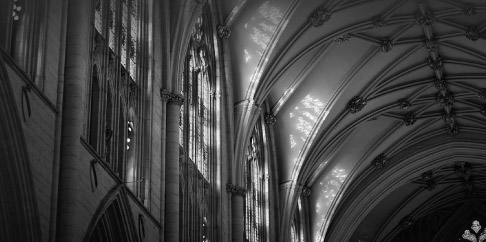
As the Virgin Mary and Jan Hus face off with each other across Prague’s most famous public space, I was starkly reminded of the differences that mar the Church of God and diminish the call to the mission of the saints of God. I hope that tonight in the glories of York Minster we can aspire to do just a bit better.
Amen.
Stay up to date with York Minster
- Event alerts
- Seasonal services
- Behind the scenes features
- Latest Minster-inspired gifts